Advertisements
Advertisements
प्रश्न
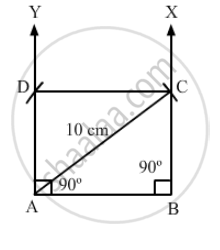
Draw a rectangle whose one side measures 8 cm and the length of each of whose diagonals is 10 cm.
Advertisements
उत्तर
(i) Draw a side AB, equal to 8 cm.
(ii) With A as the centre, draw an arc of length 10 cm.
(iii) Draw\[\angle\]ABX = 90° which intersects the arc at C.
(iv)Draw\[\angle\]= 90° .
(v) With C as the centre, draw an arc of length 8 cm.
(vi) Join CD.
Thus, ABCD is the required rectangle.
संबंधित प्रश्न
In Fig. 17.29, suppose it is known that DE = DF. Then, is ΔABC isosceles? Why or why not?
Which of the following statement is true for a rectangle?
Its diagonals are perpendicular.
Which of the following statement is true for a square?
It is a rectangle.
Which of the following statement true for a square?
Its diagonals bisect each other at right angle.
Fill in the blank in the following, so as to make the statement true:
A rectangle is a parallelogram in which .....
Prove that quadrilateral formed by the intersection of angle bisectors of all angles of a parallelogram is a rectangle.

Diagonals of a rectangle PQRS are intersecting in point M. If ∠QMR = 50° find the measure of ∠MPS.
Show that the bisectors of angles of a parallelogram form a rectangle
Quadrilateral EFGH is a rectangle in which J is the point of intersection of the diagonals. Find the value of x if JF = 8x + 4 and EG = 24x – 8.
Construct a rectangle whose one side is 3 cm and a diagonal equal to 5 cm.
