Advertisements
Advertisements
प्रश्न
Two adjacent angles of a parallelogram have equal measure. Find the measure of each of the angles of the parallelogram.
Advertisements
उत्तर
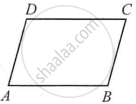
Let ABCD be a parallelogram, in which, let m∠A = m∠B = x
Since sum of two adjacent angles is 180°
∠A + ∠B = 180º
x + x = 180°
2x = 180°
x = 90º
∠C = ∠A = 90º (Opposite angles)
∠D = ∠B = 90º (Opposite angles)
Thus, each angle of the parallelogram measures 90º.
संबंधित प्रश्न
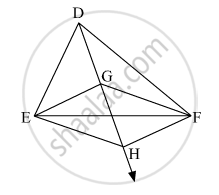
In the given figure, G is the point of concurrence of medians of ΔDEF. Take point H on ray DG such that D-G-H and DG = GH, then prove that `square`GEHF is a parallelogram.
ABCD is a parallelogram. What kind of quadrilateral is it if: AC is perpendicular to BD but is not equal to it?
Prove that the diagonals of a parallelogram bisect each other.
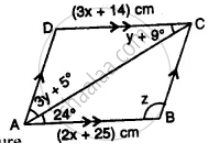
Use the information given in the alongside diagram to find the value of x, y, and z.
Iron rods a, b, c, d, e, and f are making a design in a bridge as shown in the figure. If a || b, c || d, e || f, find the marked angles between d and e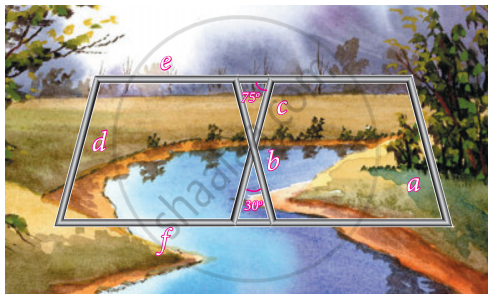
Iron rods a, b, c, d, e, and f are making a design in a bridge as shown in the figure. If a || b, c || d, e || f, find the marked angles between c and f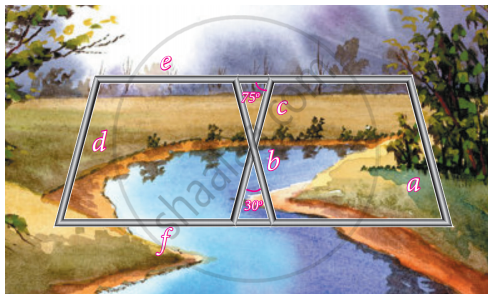
Which of the following figures satisfy the following properties?
- All sides are congruent.
- All angles are right angles.
- Opposite sides are parallel.
Two angles of a quadrilateral are each of measure 75° and the other two angles are equal. What is the measure of these two angles? Name the possible figures so formed.
ABCD is a parallelogram. The bisector of angle A intersects CD at X and bisector of angle C intersects AB at Y. Is AXCY a parallelogram? Give reason.
Construct a parallelogram HOME with HO = 6 cm, HE = 4 cm and OE = 3 cm.
