Advertisements
Advertisements
प्रश्न
Diagonals PR and QS of a rhombus PQRS are 20 cm and 48 cm respectively. Find the length of side PQ.
Advertisements
उत्तर

Diagonals of a rhombus bisect each other at right angles.
PR = 20 cm, QS = 48 cm
⇒ `"PO" = 1/2 "PR"`
= `1/2 xx 20`
= 10 cm
Similarly, QS = 48 cm
⇒ `"QO" = 1/2 "SQ"`
= `1/2 xx 48`
= 24 cm
In ΔPOQ, applying Pythagoras theorem,
OQ2 + OP2 = PQ2
⇒ 242 + 102 = PQ2
⇒ PQ2 = 576 + 100
⇒ PQ2 = 676
⇒ PQ = 26 cm
APPEARS IN
संबंधित प्रश्न
The following figure is parallelogram. Find the degree values of the unknowns x, y, z.
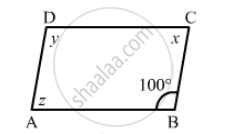
The following figure is parallelogram. Find the degree values of the unknown x, y, z.
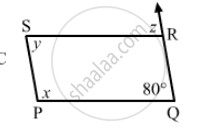
Two adjacent angles of a parallelogram are as 1 : 2. Find the measures of all the angles of the parallelogram.
The sum of two opposite angles of a parallelogram is 130°. Find all the angles of the parallelogram.
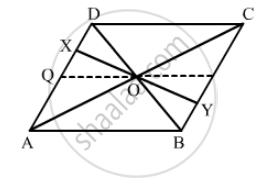
Diagonals of parallelogram ABCD intersect at O as shown in the following fegure. XY contains O, and X, Y are points on opposite sides of the parallelogram. Give reasons for each of the following:
(i) OB = OD
(ii) ∠OBY = ∠ODX
(iii) ∠BOY = ∠DOX
(iv) ∆BOY ≅ ∆DOX
Now, state if XY is bisected at O.
In the following Figure ABCD is a arallelogram, CE bisects ∠C and AF bisects ∠A. In each of the following, if the statement is true, give a reason for the same:
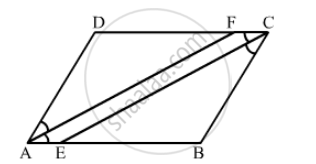
(i) ∠A = ∠C
(ii) \[\angle FAB = \frac{1}{2}\angle A\]
(iii) \[\angle DCE = \frac{1}{2}\angle C\]
(iv) \[\angle CEB = \angle FAB\]
(v) CE || AF
In a parallelogram ABCD, AB = 10 cm, AD = 6 cm. The bisector of ∠A meets DC in E, AEand BC produced meet at F. Find te length CF.
Which of the following statement is true for a rhombus?
Its diagonals are equal and perpendicular.
Fill in the blank, inthe following, so as to make the statement true:
A rhombus has all its sides of ...... length.
The diagonals of a quadrilateral are perpendicular to each other. Is such a quadrilateral always a rhombus? If your answer is 'No', draw a figure to justify your answer.
ABCD is a rhombus. If ∠ACB = 40°, find ∠ADB.
State with reason whether the following statement is ‘true’ or ‘false’.
Every parallelogram is a rhombus.
Draw a rhombus KLMN such that its side is 4 cm and m∠K = 75°.
Measure of one angle of a rhombus is 50°, find the measures of remaining three angles.
The lengths of the diagonals of a Rhombus are 12 cm and 16 cm. Find the side of the rhombus
If the diagonal of a rhombus are equal, then the rhombus is a
If all sides of a quadrilateral are equal, it is a ______.
Diagonals of a quadrilateral are perpendicular to each other. Is such a quadrilateral always a rhombus? Give a figure to justify your answer.
Construct a rhombus whose side is 5 cm and one angle is of 60°.
