Advertisements
Advertisements
प्रश्न
What was the underlying reason for John Ipe's disgust with the world?
Advertisements
उत्तर
John Ipe was disgusted with the world. He did not get his due. The moth, Pappachi discovered, was not named after him and it fuelled the fire that burnt within him, consuming him. He was ill humoured already, yet the fact that he was a retired government official without any fame, his wife who was seventeen years younger to him, still in her prime, was making good out of her pickle factory. This hurt Pappachi, it wounded his pride. He started beating Mammachi now regularly. Everything, from his, never got fame to his wife's success wounded him badly and his frustration proliferated.
APPEARS IN
संबंधित प्रश्न
Write an e-mail to the Principal of a neighbouring school requesting him/her to send a team of three members to participate in the Quiz Competition.
You had gone on a trekking expendition with a group of friends. As night closed in, you realised that you were separated from the group. Describe your initial feelings and the place where you got lost. How did you spend the night alone before you were reunited with your group?
How does a tree planter do civic good?
There are two pauses when Kaspar tells Wilhelmine in the last stanza that it was a famous victory. Nay … nay…my little girl, quoth he.What do these pauses show?
Why is the poet so much against watching television? Give two reasons.
How is he affected by the experience of seeing the daffodils?
What is the free bird metaphor for.
Thus I entered, and thus I go!
In triumphs, people have dropped down dead,
"Paid by the world, what dost thou owe
Me?"....God might question; now instead,
'Tis God shall repay: I am safer so.
Read the above lines and answer the question that follow.
Which line is a contrast to the welcome he had received.
Describe the angel. How did he look at Abou?
What is the central idea of the poem?
What thoughts are uppermost in the soldier’s mind as he talks with the old man?
What are the techniques used by Ruskin Bond to create an atmosphere of strangeness, mystery and super naturalism in the story? Can Ruskin Bond be called a visual writer? Why?
Write a short story that ends with the words “……………… I really doubt if things could have turned out any better.”
The children were delighted. The exams had been cancelled.
The soldier laid________their lives defending their country.
The character of King Richard I is presented in Ivanhoe not only with all his admirable qualities but also with his shortcomings. Elaborate with close reference to the text.
Referring closely to the essay Unbirthday and Other Presents, discuss why E V Lucas feels that `unbirthday‘ gifts are better than the regular gifts people give.
Wilfred Owen paints a horrific picture of a nightmarish memory on the battlefield. How does Duke et Decorum Est become Owen's condemnation and bitter response to war?
Write a composition (350 – 400 words) on the following:
Write an original story that begins with the words : “He was the funniest boy I had ever met. He would make everyone laugh………”
‘Working women make better mothers than women who stay at home’. Express your views either for or against this statement.
Fill in the blanks with an appropriate word:
- The teacher spoke for Raju when he was wrongly accused of stealing money.
- We can visit her at the hostel at 3 pm and 6 pm on Saturdays.
- The Sinha's have lived in New Delhi 1943.
- Little children are often afraid of the dark.
- Sneha has applied for a scholarship.
- It took Ahmed many months to get the loss of his friend.
- She turned the generous offer made by the manager.
- We were asked to take our footwear as we were entering a place of worship.
Given below is an interesting combination of words. Explain why they have been used together.
desert sky
To what is the bird’s movement compared? What is the basis for the comparison?
Combine the following sets of ideas to show the contrast between them.
(i)The Emperor commissions a painting and appreciates its outer appearance.
(ii)The artist reveals to him the true meaning of his work.
What does the phrase “strange to tell” mean?
Why does John Ipe consider retirement to be a dishonour?
You are the class representative and you have been asked by the Principal to conduct an interview of a cop. Frame 8-10 questions with the help of the following points, give introduction and conclusion.
- reasons for joining the department
- special training
- developing the skill to identify and locate criminals
- dealing with criminals
- achievements and awards.
We add ‘un-’ to make opposites. For example, true — untrue. Add ‘un’– to the word below to make its opposite. Then look up the meaning of the word you have formed in the dictionary.
qualified: ____________
The traits of the characters you meet in the extract are jumbled. Sort them out and write them in the appropriate columns.
(Shy, bold, gruff, friendly, withdrawn, perceptive, empathetic, playful, lonely, happy, gentlemanly, frank, mature, dull, sharp, adventurous.)
| Jo | Laurie | Grandpa |
Discuss with your partner and complete the web of different activities related to climbing.

Imagine that you are the fellow pilgrim and you wish to share your experience of the incident in the poem.
Write a short article about it for a magazine/journal. Also, convey what change it has brought in your life.
Write in 100 words what the cherry tree in the poem symbolises.
The poet has observed the sower closely. Express in your own words the reverence the poet has for the sower.
Your examinations are only two months ahead. Plan your schedule of studies and write in your notebook.
Writing is considered to be one of the most challenging, demanding, and lucrative careers in the world. Match the professions in table (A) with their descriptions in a table (B) and also what they are called from the table (C).
| Sr No. | A Profession | B Description | C Known as |
| 1. | Blog Writing | Writes in scientific journals, university magazines, etc as a result of their Studies and Research | a. Translator |
| 2. | Story Writing | Writes on trends or comments on issues in a column every day or weekly | b. Blogger |
| 3. | Song/Lyric Writing | Writes in National, State, and local newspapers as a staff member | c. Journalist |
| 4. | Academic Writing | Writes long stories of fiction, non-fiction, and other genres | d. Story Writer |
| 5. | Translating | Writes for theatre on genres like fiction and non-fiction, historical, etc. | e. Song Writer/Lyricist |
| 6. | Newspaper Writing | Writes lyrics/songs for films, plays, etc. on a given topic. | f. Academic Writer |
| 7. | Column Writing | Writes/Publishes an information piece, views, opinions, etc. on (www-World Wide Web) | g. Dramatist/ Playwright |
| 8. | Screen Writing | Writes in short on one or more genres of fiction/ in magazines, anthologies, etc. | h. Novelist |
| 9. | Fiction/Novel Writing | Translates an original work from one language into another | i. Screenplay Writer |
| 10. | Drama/ Play Writing | Writes Scripts for Films/ Movies/ TV etc. | j. Columnist |
Given in a mixed order below are some good human attributes of the family. Pick out from the box and write it against the line that reflects it.
Father taught the boys geometry and how to use triangles to measure big objects.
Prepare a formal invitation using the following format:
|
Mr and Mrs _______________________ solicit the pleasure of your company on the occasion of the ____________________ of their __________________ on _______________ (day), date _______________. Venue __________________ Time ____________________ (Include other requests like RSVP, No presents please, etc. at the bottom.) |
Compare the Indian Monsoon season to a powerful king of a prosperous kingdom. Write down a few similarities. Use them to compose a poem of your own.
Write about the daily routine of the 'Lord of Tartary' in 8-10 lines.
Imagine the Stranger-man narrates how the Neolithic ladies overpowered him. Write an account of the same making him the narrator.
Write a meaningful paragraph using the hints given below.
Mahesh – celebrates – 14th birthday – an old-age home – family, friends – informs home in advance – delegates tasks – friends buy things necessary – arrives home early – decorates place – balloons, colour papers – inmates gathered – cuts cake – sing-song, claps – distributes cakes – expresses his feelings – gets blessings – offers things – bedsheets, footwear, etc. needed – fun, entertainment – happy and content.
Draft Letter for the following.
You are Sadasivam. You recently visited your native town in Vellore. You happened to accompany your grandmother to your family temple. You were shocked to notice the poor condition and maintenance of the temple. Write a letter to the Editor of the local newspaper highlighting the poor condition of the temple. Also, give some suggestions and request the HRC to take steps to improve the situation.
Create a pamphlet for the following.
Make a pamphlet on the latest gadgets (Mention the variety of models, uses, needs, and availability).
Reference to context.

Draw pictures of the speakers of the above lines.
Some words have similar sound, but different meaning. Choose the correct word from the option and fill in the blank.
The squirrel has a long ______.
Look for words in the poem which sound like the words given below.
- are ______
- there ______
- flour ______
- where ______
- son ______
- threw ______
In the sentence below the capital letter, comma, full stop and question mark are missing. Put these in the correct place.
every sunday i go for a walk have breakfast read story books listen to music and watch television
The ______ sang beautifully.
Why did the grandmother accompany the author to school?
According to Mary Kom, what was the reason for her losing in the finals?
Read the information in the table below and answer the following questions.
| Sl. No | Event | Year | Affected Area |
| 1. | Earthquake | 2001 | Bhuj, Gujarat |
| 2. | Tsunami | 2004 | Coastline TN, Kerala, A.P., A&N Islands, Pondicherry |
| 3. | Floods | July 2005 | Maharashtra |
| 4. | Earthquake | 2008 | Kashmir |
| 5. | Floods | 2008 | North Bihar |
| 6. | Cyclone | 2008 | Tamil Nadu |
| 7. | Floods | 2009 | Andhra Pradesh & Karnataka |
| 8. | Cyclone | 2011 | Tamil Nadu/Cuddalore |
| 9. | Flash floods | June 2013 | Uttarkhand |
| 10. | Cyclone | Oct. 2013 | Coastline of Orissa & Jharkhand |
| 11. | Floods | Dec. 2015 | Tamil Nadu/Chennai |
| 12. | Cyclone | Dec. 2016 | Tamil Nadu/Chennai |
- What kinds of natural disasters have occurred before 2005?
- Name the disasters that are common in India.
- Mention the states often affected by disasters.
- List out the disasters that are common in North India
- Write three sentences on your inference about the data given.
Why did the author go to the photo studio?
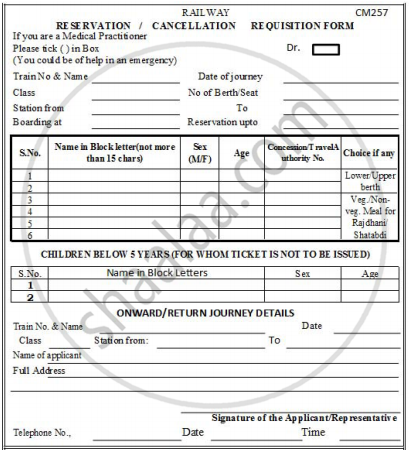
Fill in the following forms with imaginary details.
School examinations do not test intelligence. Express your views either for or against this statement
One cannot always get what one wants and sometimes it is for the best. Present your reflections on this statement.
Write a paragraph on ‘Online Shopping’ using the points in the below table.
| Advantages | Disadvantages | ||
| 1. | Time-saving | 1. | Delay in delivery |
| 2. | Variety of products | 2. | Products are not always genuine. |
| 3. | Easy to Pay | 3. | Prone to scams |
| 4. | Easy to order | 4. | At times, it is challenging to return. |
| 5. | Good discounts | 5. | Cannot see or touch the product before purchase. |
Prepare a set of questions to interview -
A famous author
These two passages are examples of a short introduction to works of art - a short review. They cover the following points:
- The name of the creator
- The theme or subject matter
- Type of art
- Individual style
- Presentation techniques
- Its effect on viewers
- Message or interpretation
Choose a book/film and review it in short using the points you have listed.
Imagine someone has invited your family to a program, and you were the only person at home when the invitation was given orally.
Write a note (4–5 lines) to pass on the message to the other people in your family. Or, write an imaginary conversation in which you pass on the message to your parents.
