Advertisements
Advertisements
प्रश्न
Form pairs. Discuss how ‘Part II’ of the story could have been different. Write your storyline in the form of bullets showing the main events.
Advertisements
उत्तर
The frantic search for a necklace for a day. Mathilde confessing to Mme. Forestier about losing the necklace and reimbursing the cost. Mme. Forestier asking for five hundred francs. difficult but the Loisels manage to pay. Mathilde learns a valuable lesson and decides not to be so materialistic in the future.
संबंधित प्रश्न
What killed the six men?
How did the last event turn out to be special?
How does the seemingly small incident described in the story reveal a significant truth about life?
Show how the story shows a conflict between humans and nature.
Fill in the blank with an appropriate word:
The poet's mother was stung __________ a scorpion.
(A) He knew the culprit but refused to admit it.
(B) Although………………………..
The delivery boy was requested to bring the parcel the next day. (Rewrite using direct speech)
"School days are the happiest days of our lives." Express your views either for or against this statement.
How does the story suggest that optimism helps to endure “the direst stress”?
What lessons do we learn from such hazardous experiences when we are face-to-face with death?
Give reasons for the following.
The boy king changed his name from Tutankhaten to Tutankhamun.
Given below is an interesting combination of words. Explain why they have been used together.
stunning artefacts
You are the class representative and you have been asked by the Principal to conduct an interview of a cop. Frame 8-10 questions with the help of the following points, give introduction and conclusion.
- reasons for joining the department
- special training
- developing the skill to identify and locate criminals
- dealing with criminals
- achievements and awards.
Your teacher will speak the word given below. Write against two new words that rhyme with it.
chop ______ ______
We add ‘un-’ to make opposites. For example, true — untrue. Add ‘un’– to the word below to make its opposite. Then look up the meaning of the word you have formed in the dictionary.
interesting: ____________
Look at these sentences.
|
|
| ‘Would’ tells us what the author used to do, or what used to happen. | ‘Could’ tells us what the author was usually able to do, or grandfather is now not able to do. |
Choose would and could to replace the italicised words in the following sentences.
Choose would and could to replace the italicised words in the following sentences.
Grandfather says, in the old days,
1. elephants were able to fly in the sky, like clouds. They were also able to change their shapes. They used to fly behind clouds and frighten them. People used to look up at the sky in wonder.
2. because there was no electricity, he used to get up with the sun, and he used to go to bed with the sun, like the birds.
3. like the owl, he was able to see quite well in the dark. He was able to tell who was coming by listening to their footsteps.
Go through the text once again and note down Devu Handa’s fond memories of Kasbai in your exercise book. One is done for you.
Devu Handa has fond memories of Kasbai. They are as follows!
(a) It needs ______________ rain.
(b) _________________
(c) _________________
Would you like to join the Indian Army/Navy/ Air force? If not, suggest other ways in which you could serve your nation.
Write an appreciation of the poem considering the following points:
- About the poem/poet/title.
- Theme
- Poetic devices, language, style
- Special features/ novelties/focusing elements
- Values, message
- Your opinion about the poem.
You have just returned after your first experience of the kite - festival in Gujarat/Ahmedabad. You were thrilled with the festivities.
Write a short report about the kite - festival for your local newspaper. Give an attractive headline, a dateline, and an account of the kite - festive. Write the report in the third person with more use of Passive voice.
Compose an imaginary dialogue between Sue and Johnsy, when they realise about what Behrman had done for Johnsy.
Write the rhyme scheme of the poem (Invictus).
Which is your favourite ‘Nature’ poem from your mother tongue? Write the poem and try to translate it into English. Your translation can be in the form of a poem or a paraphrase.
Hold a story-telling competition in which each one narrates a folk-tale or fairy-tale.
Write an appreciation of the poem.
| Point: | |
| Title | |
| Poet | |
| Rhyme scheme | |
| Favorite line | |
| Theme/Central idea | |
| Figures of speech | |
| Special features - Type of the poem, language, style, tone, implied meanings, etc. | |
| Why I like/dislike the poem |
Expand the theme in a write-up of about 20 lines.
‘Books are our real friends’

Select three words that best describe Mr. Scotti.
clever / unlucky / stupid / successful / miserable / happy.
Have you experienced any unexpected turn of events in your life? What happened? How did you feel about it at that moment? How do you feel about it now?
Write an article for your school magazine describing your experience in about 150 words.
Read the story of Neerja Bhanot. Make notes based on the table and complete it.
| Name | |
| Father’s Name & Occupation | |
| Mother’s Name & Occupation | |
| Born on | |
| Nationality | |
| State | |
| City | |
| Education |
School : |
| College: | |
| Personal Life | |
| Siblings | |
| Achievements | |
| Awards | |
| Legacy | |
| Died on | |
| Place of Death |
“I will pay tomorrow.” He said that he would pay ______.
Make the children write their own story. The following questions will help them to write. Ask them to gather information from their parents before writing and to give a title.
- When were you born?
- Where were you born?
- What is your father’s name and what is he?
- What is your mother’s name and what is she?
- What is your birth order?
- Do you have any nickname, if yes, reason for that?
- An interesting incident that happened in your life.
How did Mary Kom manage to get financial support for her trip to the USA?
Compare the two crests.
The photographer told him to ______.
How does nature communicate with the poet?
“What man calls civilization always results in deserts. Man is never on the square he uses up the fat and greenery of the earth. Each generation wastes a little more of the future with greed and lust for riches”- Don Marquis
With our modern awareness of ecology are we likely to make sufficient progress in conservation, or are we still in danger of damaging the earth beyond repair? Write a discursive essay discussing the issue being raised.
Read the following questions and answers. Form pairs and frame similar questions and answers for this website. How to use this website:
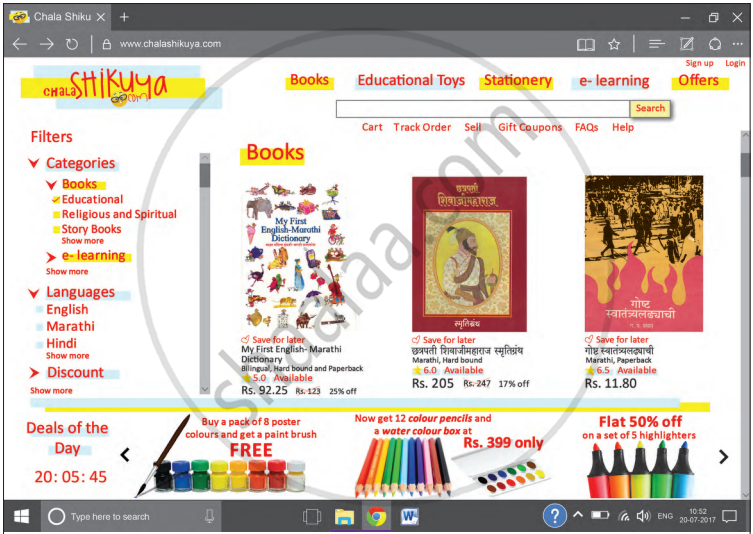
How to use this website:
- If I want to buy a story book on this website, where can I find it?
- In the categories on the left, in the options under Books you will find story books. Click that option. - I want a CD of the dictionary.
- Go to ‘e-learning’. Under that Click the ‘dictionary’ option. - Where can I look for books in the Hindi language?
-You can go to the Languages option on the left and tick the box before Hindi. - How can I find what discounts are available?
- Under the filters on left you will find discounts. - Are there any specific deals/offers on specific days?
- There is a CSY (Chalashikuya) deal. You can click on it and find out the deal of the day. - Can I purchase only one thing at a time?
- No, you can buy many things at a time. Select whatever you want and add to the cart and then browse again for another product. - When will my order be delivered?
- Maximum in 10 working days. You can also track your order by clicking the icon ‘track order.’ - There is one icon ‘Gift Coupons’. What does it mean?
- You can give a gift coupon to your friend by using this icon and he/she can purchase the product of his/her choice with the help of it. - Is this site only for purchasing?
- No, you can also sell your old books and other educational things here. - How can I find out whether the product is good or not?
- You can see the ratings and reviews of users below each product.
Work in groups and prepare an attractive wrapper or packet for any product of your choice. Prepare an advertisement for your product.
Prepare a speech to deliver in an interschool competition on ‘How to achieve success in life’ with the help of the following web chart.

- Within one minute, write as many meaningful phrases as possible using the numbers given below. Do not repeat the ideas.
- One: ______
- Two: ______
- Three: ______
- Four: ______
- Five: ______
- Six: ______
- Seven: ______
- Forty: ______
- A hundred: ______
- Try to imagine a situation/context where all the above items fit in. Describe it in 8-10 lines.
- Think of a title for your passage.
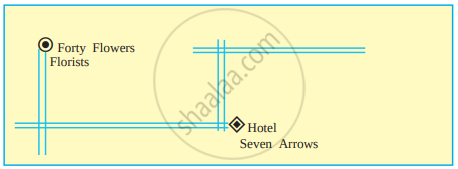
- Try to draw a map incorporating your phrases in a meaningful way. (Two examples are given below.) Write a key/index for your map.