Advertisements
Advertisements
प्रश्न
How did the narrator learn to distinguish between 'a flask' and 'a thermos'?
Advertisements
उत्तर
There was a time when the narrator went to buy tea bags and a 'flask'. This is when he came to know that the thing which he was looking for was actually known as a 'thermos' and 'flask' was something which was used to store Whisky. The reason for the narrator having limited knowledge on the subject was the fact that he hadn't consumed whiskey till then.
APPEARS IN
संबंधित प्रश्न
The poet compares the flowers to the milky way. Is the comparison apt?
How is the theme of self-awareness shown in the poem “Caged Bird” by Maya Angelou?
What is the message of Maya Angelou’s poem?
Thus I entered, and thus I go!
In triumphs, people have dropped down dead,
"Paid by the world, what dost thou owe
Me? "....God might question; now instead,
'Tis God shall repay: I am safer so.
Read the above lines and amswer the question that follow.
Give an example of Antithesis from the poem ‘The Patriot: An Old Story.’
Thus I entered, and thus I go!
In triumphs, people have dropped down dead,
"Paid by the world, what dost thou owe
Me? "....God might question; now instead,
'Tis God shall repay: I am safer so.
Read the above lines and amswer the question that follow.
What type of poetic piece ‘The Patriot: An Old Story’ is?
(A) Ramesh said, "Rajiv, please bring your physics book to school tomorrow."
(B) Ramesh………………………….
I have never worn a more ill-fitting suit. (End: …………..ever worn.)
Join the following sentence to make one complete sentence without using and, but or so.
Mala is not in the classroom. Mala is not in the library.
Re-write the following sentence according to the instructions are given. Make other changes that may be necessary, but do not change the meaning of the sentence.
As soon as the function got over. The crowd dispersed.
(Begin: Hardly had……….)
Re-write the following sentence according to the instructions are given. Make other changes that may be necessary, but do not change the meaning of the sentence.
Harish was so tired that he could not keep his eyes open.
(Begin: Harish was too……….)
Narrate an incident from your own experience when you helped a friend who was in trouble. Explain what happened. What did you do to make the situation better ?
They had to climb ____________the steep pathway to reach the top.
What difference did you notice between the reaction of the adults and the children when faced with danger?
What lessons do we learn from such hazardous experiences when we are face-to-face with death?
Make a list of items that are referred to differently in British and American English, for example, 'lift' (BE) 'elevator' (AmE).
Your teacher will speak the word given below. Write against two new words that rhyme with it.
bed ______ ______
State whether the following statement is true or false. Correct the false statement.
Fraternity means common sense.
The cherry tree is a narrative poem. Features that make it a narrative poem are given below. Justify them with proper examples.
Characters are referred to.
The cherry tree is a narrative poem. Features that make it a narrative poem are given below. Justify them with proper examples.
Incidents are arranged in sequence.
There are a number of challenges a farmer in India faces. Discuss with your friend, how it is possible to improve the condition of farmers.
| Sr. No. | Challenges | Solutions |
| 1. | Water Scarcity | Rain Water Harvesting |
| 2. | Credit and In-debtedness | |
| 3. | Land Issues | |
| 4. | Climatic changes | |
| 5. | Social Groups | |
| 6. | Lack of advanced technology | |
| 7. | Diversification | |
| 8. | Market Risks |
Write an appreciation of the poem considering the following points:
- About the poem/poet/title.
- Theme
- Poetic devices, language, style
- Special features/ novelties/focusing elements
- Values, message
- Your opinion about the poem.
The pride of any city is its skyline.
Write 5 lines about the place where you reside and what makes you feel proud of it.
There are ample career opportunities in film making and producing films.
The following professions which require different professional skills, and write them accordingly.
| Professions | Professional skills |
| 1. Actor-Male or Female | Acting, voice modulation, Body language, facial expressions, etc. |
| 2. Director | |
| 3. Producer | |
| 4. Music-director | |
| 5. Script-writer | |
| 6. Lyrist | |
| 7. Cameramen | |
| 8. Cinematographer | |
| 9. Set-designer | |
| 10. Costume-designer |
Write a few lines about yourself - your name, appearance, family, the place where you live, your school, your friends, neighbours, relatives, your likes, dislikes, hobbies, what you are good at, etc.
Now create an imaginary ‘persona’ for yourself. It can be quite different from your real self. Or, you may choose a fictional character - a character from a novel, story, etc. Write a few lines about this imaginary persona and introduce yourself in that role.
| Real Self | Imaginary Persona |
|
Hi, I am ____________________ ____________________________ ____________________________ |
Hi, I am ____________________ ____________________________ ____________________________ |
Write a few lines about what Mathilde had and what she dreamt about.
Form groups of 5-8. Translate the play into your mother tongue (or Hindi) as a group activity. Enact the translation in the classroom.
Gather information on any one of the following by talking to your elders, family members, and from other sources in your mother tongue and write a short note on it in English.
A special type of embroidery
Write a short passage/essay on ‘Women Power’ in the Neolithic, Medieval, and Present Times.
‘..... and that’s how I realized that courage and hope can help me overcome any major mishap/problem in life.’ Write an episode/experience from your own life that leads to the above conclusion.
Write the reason in your own words.
Akbar strongly desired to hear Ostad sing.
Prepare a set of questions to interview:
a person who has just returned from a trek in the woods.
Write a speech for your school Literary Association celebration with the given lead.
| 1) Opening | |
| 2) Purpose | |
| 3) Audience | |
| 4) Language – Some Good Describing Words (Adverbs And Adjectives), Emotive Words, Imagery etc. | |
| 5) Ending |
On the next day, Mr. Scotti was __________ at how the local people responded to his queries.
Your friend has presented a beautiful art piece on your birthday. Write a letter to her appreciating her art work.
“The Himalayas are the highest mountain ranges.” He knew that the Himalayas ______ the highest mountain ranges.
Arrange the picture in order by writing the numbers 1,2,3 and 4 in the given boxes and write this familiar story in about 100 words.
Make use of the words given below.
| thirsty, village, pitcher, disappointment, pebbles, water level |
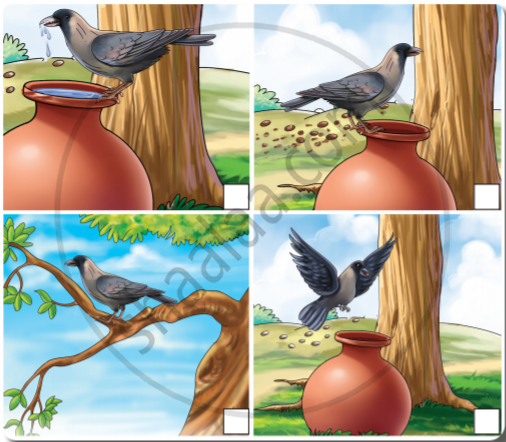
One hot day, a thirsty crow _____________________________________________________________
__________________________________________________________________________________________
Complete the paragraph with suitable words from the box.
| around, across, with, along, to, after, next to, into, from. |
One day, as I was walking ______ the bank of the river, I saw my friend running ______ the field. He was calling my name and waving ______ me. I stopped and waited. ______ sometime he reached where I was standing. He said, “I went all ______ the town looking for you. I have some exciting news to share ______ you. Do you remember the old house ______ the neem tree? Guess who is moving ______ that house? Janak Das, the great magician. Now we can learn lots of magic tricks ______ him.”
The word in the sentence is jumbled. Write them in order.
I around me looked.
The word in the sentence is jumbled. Write them in order.
was afraid I now.
Correct the use of the describing word in the following sentence.
Which is the lightest of the two parcels?
Punctuate the following sentence.
she fed the baby washed the dishes put the lights off and went to sleep.
Find one word from the story that means
to be seen nowhere d ______.
The travellers rested under the ______ of trees.
Describe the man awaiting the arrival of his friend.
When and how did Bob realise that the tall man was not his friend?
What did Bob share with the cop about their friendship?
To your shock, you find out that your close friend is indulging in some wrong activity. Will you avoid him/her or try to correct him/her? Give reasons for your answer.
Lack of adequate financial resources and sponsorships often affect sportspersons. How is this evident from Mary Kom’s life?
How would Sletherby gain from his friendship with Honoria Saltpen–Jago?
Based on your understanding of the play, complete the Graphic Organiser (GO) suitably.
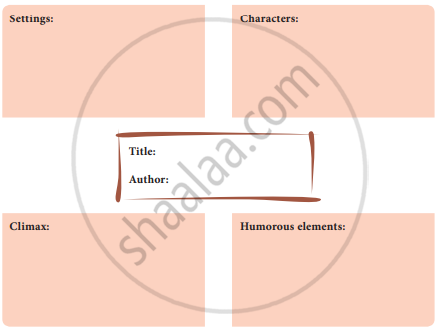
Answer the following question as briefly as possible and with close reference to the relevant text.
Referring closely to the poem, We are the Music Makers, refer to any two examples given by the poet which identify poets and singers as “movers and shakers.”
“What man calls civilization always results in deserts. Man is never on the square he uses up the fat and greenery of the earth. Each generation wastes a little more of the future with greed and lust for riches”- Don Marquis
With our modern awareness of ecology are we likely to make sufficient progress in conservation, or are we still in danger of damaging the earth beyond repair? Write a discursive essay discussing the issue being raised.
______ was Portia’s; faithful servant.
Read the following questions and answers. Form pairs and frame similar questions and answers for this website. How to use this website:
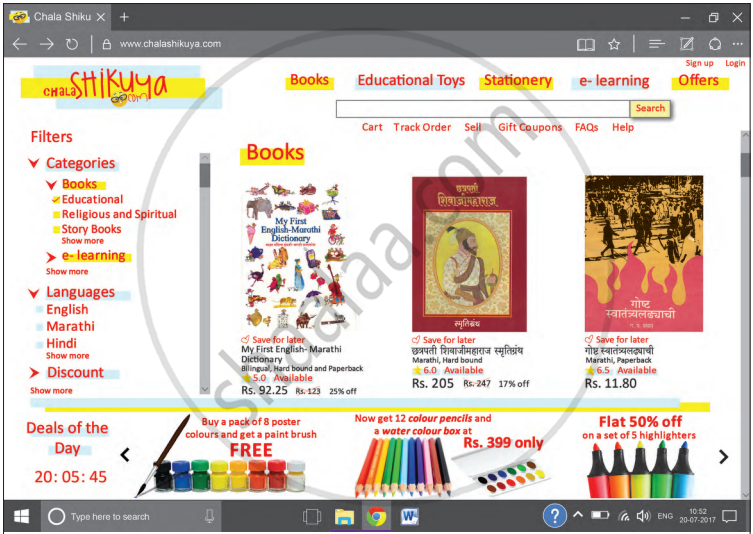
How to use this website:
- If I want to buy a story book on this website, where can I find it?
- In the categories on the left, in the options under Books you will find story books. Click that option. - I want a CD of the dictionary.
- Go to ‘e-learning’. Under that Click the ‘dictionary’ option. - Where can I look for books in the Hindi language?
-You can go to the Languages option on the left and tick the box before Hindi. - How can I find what discounts are available?
- Under the filters on left you will find discounts. - Are there any specific deals/offers on specific days?
- There is a CSY (Chalashikuya) deal. You can click on it and find out the deal of the day. - Can I purchase only one thing at a time?
- No, you can buy many things at a time. Select whatever you want and add to the cart and then browse again for another product. - When will my order be delivered?
- Maximum in 10 working days. You can also track your order by clicking the icon ‘track order.’ - There is one icon ‘Gift Coupons’. What does it mean?
- You can give a gift coupon to your friend by using this icon and he/she can purchase the product of his/her choice with the help of it. - Is this site only for purchasing?
- No, you can also sell your old books and other educational things here. - How can I find out whether the product is good or not?
- You can see the ratings and reviews of users below each product.
These two passages are examples of a short introduction to works of art - a short review. They cover the following points:
- The name of the creator
- The theme or subject matter
- Type of art
- Individual style
- Presentation techniques
- Its effect on viewers
- Message or interpretation
What points will you include if you had to review a book or film or a play? List the points.
Write about your own experience. Do you remember an occasion when you did something successfully for the first time? Write about it in short (10-12 lines). Prepare an outline of your composition before you write it.
Write a letter to your father asking permission to go on an educational tour.
Referring closely to any two instances from the Acts studied, show how music is used to influence the course of events/action in the play, Write your answer in a short paragraph of about 200-250 words.
