Write a short passage/essay on ‘Women Power’ in the Neolithic, Medieval, and Present Times.
Advertisements
प्रश्न
Write a short passage/essay on ‘Women Power’ in the Neolithic, Medieval, and Present Times.
Advertisements
उत्तर
As humans have evolved over the years, so has mankind processed. Women in the olden days, like the Neolithic age, only did the household work of gathering food, cooking, taking care of the children, and cleaning work. In medieval times, women got a little more important and hence, were allowed to educate themselves, but nevertheless were not allowed to work and earn a penny for the house.
In present times, women are empowered and educated. They can work at home and also work outside to earn money for the house. They are allowed to go out with their friends. They educate themselves and acquire the highest degrees. Today, women can be entrepreneurs, doctors, engineers, CAs and many more opportunities are open for them.
APPEARS IN
संबंधित प्रश्न
Which of these words would you use to describe Santosh Yadav? Find reasons in the text to support your choices, and write a couple of paragraphs describing Santosh’s character
| contented | determined | resourceful | polite | adventurous | considerate |
| weak-willed | fearful |
independent |
pessimistic |
patient | persevering |
Explain:
‘Some are aglow with the bloom that cleaves
To the limpid glory of new born leaves.’
Read the following passage carefully and answer the questions that follow:
Lying in bed, Swami realized with a shudder that it was Monday morning. It looked as though only a moment ago, it had been the last period on Friday; already, Monday was here. He hoped that an earthquake would reduce the school building to dust but that my good building, Albert Mission School, had withstood similar prayers for over a hundred years now.
At nine o'clock, Swaminathan wailed, “I have a headache.”
His mother said, “Why don’t you go to school in a bullock cart?”
“So that I may be completely dead at the other end? Have you any idea what it means to be jolted in a cart?”
“Have you any important lessons today?”
“Important! Bah! That geography teacher has been teaching the same lesson for over a year now. And we have arithmetic, which means for a whole period we are going to be beaten by the teacher............ Important lessons!”
And Mother generously suggested that Swami might stay at home.
At 9:30, when he ought to have been lining up in the school prayer hall, Swami was lying on the bench in Mother’s room.
Father asked him, “Have you no school today?”
“Headache,” Swami replied,
“Nonsense! Dress up and go.”
“Headache.”
“Loaf about less on Sundays, and you will be without a headache on Monday.”
Swami knew how stubborn his father could be and changed his tactics.
“I can’t go so late to class.”
“I agree, but you’ll have to; it is your own fault. You should have asked me before deciding to stay away.”
“What will the teacher think if I go so late?”
“Tell him you had a headache, and so are late.”
“He will beat me if I say so.”
“Will he? Let us see. What is his name?”
“Mr. Samuel.”
“Does he beat the boys?”
“He is very violent, especially with boys who come late. Some days ago, a boy was made to stay on his knees for a whole period in a corner of the class because he came late, and after getting six cuts from the cane and having his ears twisted, I wouldn’t like to go late to Mr Samuel’s class.”
“If he is so violent, why not tell your headmaster about it?”
“They say that even the headmaster is afraid of him. He is such a violent man.”
And then Swami gave a lurid account of Samuel’s violence; how when he started caning, he would not stop till he saw blood on the boy’s hand, which he made the boy press to his forehead like a Vermillion marking. Swami hoped his father would be made to see that he couldn’t go to his class late. But his father’s behaviour took an unexpected turn. He became excited.
“What do these people mean by beating our children? They must be driven out of service. I will see…..”
The result was that he proposed to send Swami late to his class as a kind of challenge. He was also going to send a letter with Swami to the headmaster. No amount of protest from Swami was of any avail: Swami had to go to school.
By the time he was ready, his father had composed a long letter to the headmaster, put it in an envelope, and sealed it.
“What have you written, father?” Swaminathan asked apprehensively.
“Nothing for you. Give it to your headmaster and go to your class.”
Swami’s father did not know the truth—that, actually, Mr. Samuel was a very kind gentleman.
(a) Give the meaning of each of the following words as used in the passage. (3)
One-word answers or short phrases will be accepted.
- jolted
- stubborn
- avail
(b) Answer the following questions briefly in your own words:
- What did Swami wish for on a Monday morning? Why was his wish unlikely to be answered? (2)
- Which sentence tells us that Swami’s father was completely unsympathetic to his son’s headache? (2)
- In what way was Swami’s mother’s response different from his father’s? (2)
- Why did Swami give a colourful account of Mr. Samuel to his father? (2)
- In what way did Father’s behaviour take an unexpected turn? (2)
- What was Swami finally ordered to do by his father? (2)
(c)
(i) In not more than 60 words, describe how Swami tries to prove that Mr. Samuel is a violent man. (8)
(ii) Give a title to your summary in 3
(c). Give a reason to justify your choice. (2)
In what ways do you think we could help prevent the extinction of languages and dialects?
Find out information about the Mahavastra of Maharashtra - Paithani.
Imagine that you are a compere of a ‘Prize Distribution Ceremony’ of your college. Write a script for the same.
You can take the help of the following points.
- Introduction – A brief introduction of the programme / function / show
- Welcome speech – Welcome to all guests. Felicitation – felicitation of the guests (the principal, vice-principal, etc.).
- Lighting the lamp
- Welcome song
- Main events
- Vote of thanks
Form groups and discuss each element of planning an interview and prepare notes on each element.
- Format - Structure: ......................
- Size/Length - How much: ......................
- Do’s and Dont’s - Rules and Regulations: ......................
- Type of Questions - Yes/No questions or Wh Type: ......................
Find more topics from your Environmental Studies or Mathematics textbooks for drawing tree diagrams. Draw and label the diagrams.
| Life on earth began with unicellular I organisms known as protozoa. The following are the stages of evolution of animals. Invertebrates are animals without a backbone, for e.g., a snail. The vertebrates are animals which have a backbone. E.g., Aquatic animals like fish. Animals which: live in water and also on land are called amphibians. E.g. A frog. A few invertebrates are worms and mosquitoes and a few I vertebrates are reptiles. |
How do you behave under the spells of different moods?
Observe the tourist leaflets given and answer the following.
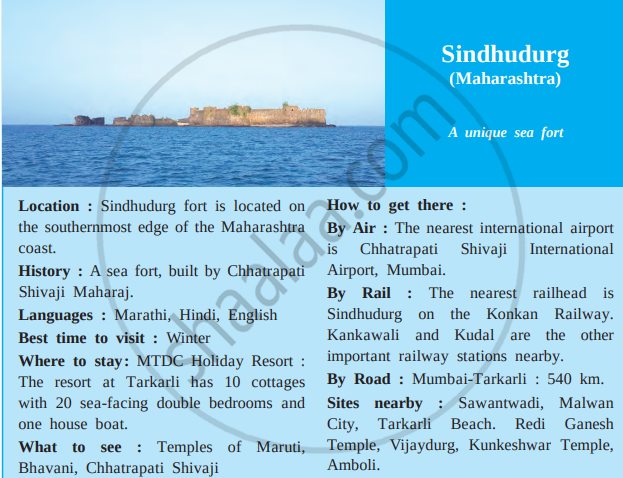

- Which places do these leaflets describe?
- What are the main points given in each leaflet?
- How can one reach Tadoba?
- Which is the best season to visit Tadoba? Why?
- List tourism-related words, e.g., tourist, booking etc.
