Advertisements
Advertisements
प्रश्न
Which of the following bacteria is not a source of restriction endonuclease?
विकल्प
Haemophilus influenzae
Escherichia coli
Entamoeba coli
Bacillus amyloliquefaciens
Advertisements
उत्तर
Entamoeba coli
APPEARS IN
संबंधित प्रश्न
Suggest a technique to a researcher who needs to separate fragments of DNA.
Name the enzymes that are used for the isolation of DNA from bacterial and fungal cells for recombinant DNA technology.
Name and describe the technique that helps in separating the DNA fragments formed by the use of restriction endonuclease
Make a chart (with diagrammatic representation) showing a restriction enzyme, the substrate DNA on which it acts, the site at which it cuts DNA and the product it produces.
Distinguish between exonuclease and endonuclease.
How does restriction endonuclease function?
Answer the following question.
Write the use of restriction endonuclease in the formation of recombinant DNA.
DNA fragments separate according to size through?
How does one visualise DNA on an agarose gel?
CTTAAG
GAATTC
- What are such sequences called? Name the enzyme used that recognizes such nucleotide sequences.
- What is their significance in biotechnology?
Given below is the stepwise schematic representation of the process of electrophoresis. Identify the 'alphabets' representing
- Anode end
- smallest/lightest DNA strand in the matrix
- Agarose gel
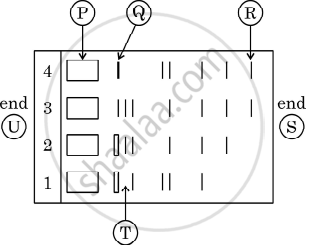
What is elution?
State the principle involved in separation of DNA fragments using gel electrophoresis.
How are DNA fragments visualised once they are separated by gel electrophoresis?
Hind II always cuts DNA molecules at a particular point called recognition sequence and it consists of ______.
How do exonucleases differ fundamentally from endonucleases in their enzymatic site of action?
In the restriction endonuclease EcoRI, what do the letter 'R' and the Roman numeral 'I' represent?
What is the origin of agarose, the matrix most commonly used in gel electrophoresis?
What is the process called when desired, separated DNA bands are physically cut out from the agarose gel and extracted from the gel piece?
