Advertisements
Online Mock Tests
Chapters
▶ 2: Chemical Bonding
3: Acids, Bases and Salts
4: Analytical Chemistry
5: Mole concept and Stoichiometry
6: Electrolysis
7: Metallurgy
8: Study of Compounds A. Hydrogen Chloride
9: Study of Compounds B. Ammonia
10: Study of Compounds C. Nitric Acid
11: Study of Compounds D. Sulphuric Acid
12: Organic Chemistry
13: Practical Work
![S.P. Singh solutions for Concise Chemistry [English] Class 10 ICSE chapter 2 - Chemical Bonding - Shaalaa.com](/images/concise-chemistry-english-class-10-icse_6:7b16b8cbeb0b4ebab074df2efa4502e0.jpg "S.P. Singh solutions for Concise Chemistry [English] Class 10 ICSE chapter 2 - Chemical Bonding")
Advertisements
Solutions for Chapter 2: Chemical Bonding
Below listed, you can find solutions for Chapter 2 of CISCE S.P. Singh for Concise Chemistry [English] Class 10 ICSE.
S.P. Singh solutions for Concise Chemistry [English] Class 10 ICSE 2 Chemical Bonding lntext Questions [Pages 26 - 34]
How do atoms attain noble gas configuration?
Define a chemical bond.
Define an electrovalent bond.
Define a covalent bond.
What are the conditions for the formation of an electrovalent bond?
An atom X has three electrons more than the noble gas configuration. What type of ion will it form?
An atom X has three electrons more than the noble gas configuration. Write the formula of its sulphate.
An atom X has three electrons more than the noble gas configuration. Write the formula of its nitrate.
An atom X has three electrons more than the noble gas configuration. Write the formula of its phosphate.
An atom X has three electrons more than the noble gas configuration. Write the formula of its carbonate.
An atom X has three electrons more than the noble gas configuration. Write the formula of its hydroxide.
Mention the basic tendency of an atom which makes it to combine with other atoms.
The element X has the electronic configuration 2, 8, 18, 8, 1. Without identifying X,
- predict the sign and charge on a simple ion of X.
- write if X will be an oxidising agent or a reducing agent and why.
In the formation of the compound XY2, an atom X gives one electron to each Y atom. What is the nature of bond in XY2? Draw the electron dot structure of this compound.
An atom X has 2, 8, 7 electrons in its shell. It combines with Y having 1 electron in its outermost shell.
- What type of bond will be formed between X and Y?
- Write the formula of the compound formed.
Explain with the help of ionic equation and electron dot structural diagram the formation of the following electrovalent compound.
NaCl
Explain with the help of ionic equation and electron dot structural diagram the formation of the following electrovalent compound.
MgCl2
Explain with the help of ionic equation and electron dot structural diagram the formation of the following electrovalent compound.
CaO
Compare:
Sodium atom and Sodium ion, with respect to
- atomic structure
- electrical state
- chemical action
- toxicity
Compare:
Chlorine atom and chloride ion, with respect to
- atomic structure
- electrical state
- chemical action
- toxicity
The electronic configuration of fluoride ion is the same as that of a neon atom. What is the difference between the two?
State the following is a reduction reaction or oxidation reaction.
\[\ce{Pb -> Pb^2+ + 2e-}\]
State the following is a reduction reaction or oxidation reaction.
\[\ce{Fe^2+ - e- -> Fe^3+}\]
State the following is a reduction reaction or oxidation reaction.
\[\ce{A^3+ + e- -> A^2+}\]
State the following is a reduction reaction or oxidation reaction.
\[\ce{Cu -> Cu^2+}\]
What do you understand by redox reactions?
Explain oxidation and reduction in terms of loss or gain of electrons.
Explain formation of electrovalent compound is a redox reaction.
Divide the following redox reaction into oxidation and reduction half-reaction.
\[\ce{Zn + Pb^2+ -> Zn^2+ + Pb}\]
Divide the following redox reaction into oxidation and reduction half-reaction.
\[\ce{Zn + Cu^2+ -> Zn^2+ + Cu}\]
Divide the following redox reaction into oxidation and reduction half-reaction.
\[\ce{Cl2 + 2Br- -> Br2 + 2Cl-}\]
Divide the following redox reaction into oxidation and reduction half-reaction.
\[\ce{Sn^2+ + 2Hg^2+ -> Sn^4+ + Hg2^2+}\]
Divide the following redox reaction into oxidation and reduction half-reaction.
\[\ce{2Cu+ -> Cu + Cu^2+}\]
Potassium (at No.19) and chlorine (at No.17) react to form a compound. Explain the formation of the compound on the basis of oxidation.
Potassium (at No.19) and chlorine (at No.17) react to form a compound. Explain the formation of the compound on the basis of reduction.
Potassium (at No.19) and chlorine (at No.17) react to form a compound. Explain the formation of the compound on the basis of oxidizing agent.
Potassium (at No.19) and chlorine (at No.17) react to form a compound. Explain the formation of the compound on the basis of reducing agent.
What are the conditions necessary for the formation of covalent molecules?
Elements A, B and C have atomic number 17, 19 and 10 respectively.
- State which one is:
- a non-metal
- a metal,
- chemically inert?
-
Write down the formula of the compound formed by two of the above elements.
Draw the electron dot diagram and structure of nitrogen molecule.
Draw the electron dot diagram and structure of magnesium chloride.
Draw electron - dot structure and structural formula of methane.
What is the difference between ionic compounds and polar covalent compounds?
What is the difference between ionic compounds and covalent compounds?
What is the difference between a polar covalent compound and a non-polar covalent compound?
A solid is crystalline, has a high melting point and is water soluble. Describe the nature of the solid.
What do you understand by dipole (polar) molecule?
Explain dipole (polar) molecule by taking hydrogen chloride as an example.
Explain the bonding in methane molecule using electron dot structure.
Methane molecule is non-polar molecule. Explain.
Give the characteristic properties of electrovalent compounds.
Give the characteristic properties of covalent compounds.
State the type of bond formed when the combining atom has zero E.N. difference.
State the type of bond formed when the combining atom has small E.N. difference.
State the type of bond formed when the combining atom has a large E.N. difference.
State the type of bond formed, and draw Lewis structure of water.
State the type of bond formed, and draw Lewis structure of calcium oxide.
Explain the following:
Electrovalent compounds conduct electricity.
Explain the following:
Electrovalent compounds have a high melting point and boiling point while covalent compounds have low melting and boiling points.
Explain the following:
Electrovalent compounds dissolve in water whereas covalent compounds do not.
Explain the following:
Electrovalent compounds are usually hard crystals.
Explain the following:
Polar covalent compounds conduct electricity?
Explain the following:
Water is a polar covalent molecule.
Elements X, Y, and Z have atomic numbers 6, 9 and 12 respectively. Which one forms an anion?
Elements X, Y, and Z have atomic numbers 6, 9 and 12 respectively. Which one forms a cation?
Elements X, Y, and Z have atomic numbers 6, 9 and 12 respectively. Which one :
State type of bond between Y and Z and give its molecular formula.
Taking MgCI2 as an electrovalent compound, CCI4 as a covalent compound, give four differences between electrovalent and covalent compounds.
Potassium chloride is an electrovalent compound, while hydrogen chloride is a covalent compound. But, both conducts electricity in their aqueous solutions. Explain.
Draw the electron dot structure of the covalent compound methane (non polar) and HCl (polar) and give two difference between them.
Name two compounds that are covalent when taken pure but produce ions when dissolved in water.
An element M burns in oxygen to form an ionic bond MO. Write the formula of the compounds formed if this element is made to combine with chlorine and sulphur separately.
Element A has 2 electrons in its M shell. Element B has atomic number 7.
- Write equations to show how A and B form ions.
- If B is a diatomic gas, write the equation for the direct combination of A and B to form a compound.
- If the compound formed between A and B is melted and an electric current is passed through the molten compound, the element A will be obtained at the ______ and B at the ______ of the electrolytic cell.
Element M forms a chloride with the formula MCI2 which is a solid with high melting point. M would most likely be in the group in which ______ is placed.
Na
Mg
Al
Si
Complete the following:
| Sodium | Phosphorus | Carbon | |
| Formula of chloride | |||
| Nature of bonding | |||
| Physical state of chloride |
Compound X consists of molecules.
Choose the letter corresponding to the correct answer from the options A, B, C and D given below:
The type of bonding in X will be ______.
ionic
electrovalent
covalent
molecular
Compound X consists of molecules.
Choose the letter corresponding to the correct answer from the options A, B, C and D given below:
X is likely to have a ______.
low melting point and high boiling point.
high melting point and low boiling point.
low melting point and low boiling point.
high melting point and high boiling point.
Compound X consists of molecules.
Choose the letter corresponding to the correct answer from the options A, B, C and D given below:
In the liquid state, X will ______.
become ionic
be an electrolyte
conduct electricity
not conduct electricity
S.P. Singh solutions for Concise Chemistry [English] Class 10 ICSE 2 Chemical Bonding EXERCISE-2 [Pages 37 - 39]
MULTIPLE CHOICE TYPE: (Choose the correct answer from the options given below).
The property which is characteristic of an electrovalent compound is that ______.
it is easily vaporised
it has a high melting point
it is a weak electrolyte
it often exists as a liquid
When a metal atom becomes an ion ______.
it loses electrons and is oxidised
it gains electrons and is reduced
it gains electrons and is oxidised
it loses electrons and is reduced
Among the following compounds identify the compound that has all three bonds (ionic, covalent and coordinate bond).
Ammonia
Ammonium chloride
Sodium hydroxide
Calcium chloride
Which of the following is not a typical property of an ionic compound?
High melting point
Conducts electricity in the molten and the aqueous solution state.
Insoluble in water
Exist as oppositely charged ions even in the solid state
Select the correct answer from A, B, C and D.
Metals lose electrons during ionization this change is called ______.
Oxidation
Reduction
Redox
Displacement
A Compound 'X' consists of only molecules. Hence 'X' will have
a Crystalline hard structure
A low melting point and low boiling point
An ionic bond
A strong force of attraction between its molecules
The molecule which contains a triple covalent bond is ______.
ammonia
methane
water
nitrogen
The formation of a covalent bond between two atoms is favoured when:
P both the atoms have a large difference in electronegativity
Q both the atoms have high electron affinity
R both the atoms have high electronegativity
Only P.
Only Q.
Both P and Q.
Both Q and R.
The following questions are Assertion-Reason based questions. Choose the answer based on the codes given below.
Assertion (A): If the electron affinity value is high, anions are formed easily.
Reason (R): Ionic bonding is favoured by high electron affinity of one of the atoms.
Both A and R are true and R is the correct explanation of A.
Both A and R are true but R is not the correct explanation of A.
A is true but R is false.
A is false but R is true.
Assertion (A): Atoms can combine either by the transfer of valence electrons from one atom to another or by sharing of valence electrons.
Reason (R): Sharing and transfer of valence electrons is done by atoms to have an octet in their valence shell.
Both A and R are true and R is the correct explanation of A.
Both A and R are true but R is not the correct explanation of A.
A is true but R is false.
A is false but R is true.
Assertion (A): A pair of electrons not shared with any other atom is known as a lone pair.
Reason (R): Ammonium ion has a lone pair.
Both A and R are true and R is the correct explanation of A.
Both A and R are true but R is not the correct explanation of A.
A is true but R is false.
A is false but R is true.
Assertion (A): Electrovalent compounds conduct electricity even in solid state.
Reason (R): Electrovalent compounds are composed of ions.
Both A and R are true and R is the correct explanation of A.
Both A and R are true but R is not the correct explanation of A.
A is true but R is false.
A is false but R is true.
Select the correct word from the brackets:
Complete the following:
When the nuclei of two different reacting atoms are of ______ mass, then a bond so formed is called ______ covalent bond. (equal, unequal, polar, non-polar)
Complete the following:
In case of non-polar covalent bond, the covalent bond is formed in the ______ of atoms and shared electrons are ______ distributed. (corner, middle, equally, unequally)
Complete the following:
Ionic or electrovalent compounds do not conduct electricity in their ______ state.
fused
solid
Complete the following:
The ions in ______ compounds are held very strongly due to strong ______ forces. (electrovalent, covalent, electromagnetic, electrostatic).
In covalent compounds, the bond is formed due to ______ of electrons.
sharing
transfer
Electrovalent compounds have a ______ boiling point.
low
high
Give one word or phrase for the following:
Formation of ions from molecules.
What is the term defined below?
A bond formed by a shared pair of electrons with both electrons coming from the same atom.
What is the term defined below?
A bond formed by a shared pair of electrons, each bonding atom contributing one electron to the pair.
Give two example in the following case:
Co-ordinate bond compounds
Give two example in following case:
Solid covalent compounds
Give two example in following case:
Gaseous polar covalent compound.
Give two example in following case:
Gaseous non polar covalent compound.
Give two example in following case:
Liquid non polar covalent compound.
Give an example in the following case:
Compound with electrovalent and covalent bond
Give an example in the following case:
Compound with all three types of bonds.
In the formation of magnesium chloride (by direct combination between magnesium and chlorine), name the substance that is oxidized and the substance that is reduced.
Electrons are getting added to an element Y.
- Is Y getting oxidized or reduced?
- Which electrode will Y migrate to during the process of electrolysis?
Element ‘X’ forms an oxide with the formula X2O3 which is a solid with high melting point. ‘X’ would most likely be placed in the group of the Periodic Table as:
-
- Na
- Mg
- Al
- Si
- Justify your answer in the above question (1).
What do you understand by lone pair of electrons ?
SHORT ANSWER TYPE:
State the type of bonding in the following molecule.
Water
State the type of Bonding in the following molecule:
Calcium oxide
State the type of bonding in the following molecule.
Hydroxyl ion
State the type of bonding in the following molecule.
Methane
State the type of bonding in the following molecule.
Ammonium ion
State the type of bonding in the following molecule.
Ammonium chloride
Give a reason as to why hydrogen chloride can be termed as a polar covalent compound.
Why do covalent compounds exist as gases, liquids or soft solids?
Explain why carbon tetrachloride does not dissolve in water.
There are three elements E, F, G with atomic numbers 19, 8 and 17 respectively. State the type of chemical bond in this compound.
A compound is formed between atoms A and B. The electronic configuration of A is 2, 8, 1 and B is 2, 6.
- Write the equation of the formation of ions of A and B.
- Why do A and B form ions?
- Which of the following can form a compound?
- A and A
- A and B
- B and B
Also state the type of bonding present in the compound.
- If A and B combines, which of them will get oxidised?
- Draw an electron dot diagram of the ionic compound formed in part (c).
- Write the formula of the compound formed in part (c) which has a
- high melting and boiling point
- gaseous compound
- good conductor of electricity in molten state.
LONG ANSWER TYPE:
Define a coordinate bond.
Give the conditions for coordinate bond formation.
Draw an electron dot diagram for the formation of the following. State the type of bonding present in them.
Hydronium ion.
Draw an electron dot diagram for the formation of the following. State the type of bonding present in them.
Ammonium ion
Draw an electron dot diagram for the formation of the following. State the type of bonding present in them.
Hydroxyl ion
How many atoms of each kind are present in the following molecule:
Calcium oxide
How many atoms of each kind are present in the following molecule:
Chlorine
How many atoms of each kind are present in the following molecule:
water
How many atoms of each kind are present in the following molecule:
carbon tetrachloride
How many electrons are required or released by each atom in calcium oxide to attain the nearest noble gas configuration?
How many electrons are required or released by each atom in chlorine to attain the nearest noble gas configuration?
How many electrons are required or released by each atom in water molecule to attain the nearest noble gas configuration?
How many electrons are required or released by each atom in carbon tetrachloride to attain the nearest noble gas configuration?
Acids dissolve in water and produce positively charged ions. Draw the structure of these positive ions.
- Elements Q and S react together to form an ionic compound. Under normal conditions, which physical state will the compound QS exist in?
- Can Q and S, both be metals? Justify your answer.
Draw the structure for carbon tetrachloride and explain the type of bonding present.
Compare the compounds carbon tetrachloride and sodium chloride with regard to solubility in water and electrical conductivity.
Draw an electron dot diagram for the formation of the following. State the type of bonding present in them.
Hydronium ion.
By drawing an electron dot diagram, show the lone pair effect leading to the formation of the ammonium ion from ammonia gas and hydrogen ion.
The following table shows the electronic configuration of the elements W, X, Y, Z:
| Element | W | X | Y | Z |
| Electronic Configuration | 2, 8, 1 | 2, 8, 7 | 2, 5 | 1 |
Answer the following questions based on the table above:
- What type of bond is formed between
- W and X
- Y and Z
- What is the formula of the compound formed between
- X and Z
- W and X
Study the extract of the Periodic Table given below and answer the questions that follow. Give the alphabet corresponding to the element in question. DO NOT repeat an element.
- Which element forms covalent compound with G?
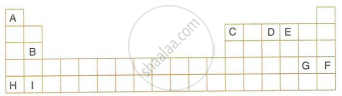
- The ion of which element will migrate towards the cathode during electrolysis?
- Which non-metallic element has the valency 2?
- Which is an inert gas?
- Which element has the lowest electronegativity in the second column?
- Which element is the most metallic?
- State the type of bond formed between I and E. Write its formula.
- Draw the electron dot diagram of the compound formed between I and G.
Solutions for 2: Chemical Bonding
S.P. Singh solutions for Concise Chemistry [English] Class 10 ICSE chapter 2 - Chemical Bonding
Shaalaa.com has the CISCE Mathematics Concise Chemistry [English] Class 10 ICSE CISCE solutions in a manner that help students grasp basic concepts better and faster. The detailed, step-by-step solutions will help you understand the concepts better and clarify any confusion. S.P. Singh solutions for Mathematics Concise Chemistry [English] Class 10 ICSE CISCE 2 (Chemical Bonding) include all questions with answers and detailed explanations. This will clear students' doubts about questions and improve their application skills while preparing for board exams.
Further, we at Shaalaa.com provide such solutions so students can prepare for written exams. S.P. Singh textbook solutions can be a core help for self-study and provide excellent self-help guidance for students.
Concepts covered in Concise Chemistry [English] Class 10 ICSE chapter 2 Chemical Bonding are Non-Polar and Polar Covalent Compounds, Types of Covalent Bonds, Formation of Covalent Bond, Properties and Comparison of Electrovalent and Covalent Compounds, Coordinate Bond, The Covalent Bond, Ionic or Electrovalent Bond, Concept of Chemical Bonding, Effect of Electricity on Electrovalent and Covalent Compounds, Conditions for the Formation of an Electrovalent (or ionic) Bond, Structures of Some Electrovalent Compounds, Non-Polar and Polar Covalent Compounds, Types of Covalent Bonds, Formation of Covalent Bond, Properties and Comparison of Electrovalent and Covalent Compounds, Coordinate Bond, The Covalent Bond, Ionic or Electrovalent Bond, Concept of Chemical Bonding, Effect of Electricity on Electrovalent and Covalent Compounds, Conditions for the Formation of an Electrovalent (or ionic) Bond, Structures of Some Electrovalent Compounds, Non-Polar and Polar Covalent Compounds, Types of Covalent Bonds, Formation of Covalent Bond, Properties and Comparison of Electrovalent and Covalent Compounds, Coordinate Bond, The Covalent Bond, Ionic or Electrovalent Bond, Concept of Chemical Bonding, Effect of Electricity on Electrovalent and Covalent Compounds, Conditions for the Formation of an Electrovalent (or ionic) Bond, Structures of Some Electrovalent Compounds.
Using S.P. Singh Concise Chemistry [English] Class 10 ICSE solutions Chemical Bonding exercise by students is an easy way to prepare for the exams, as they involve solutions arranged chapter-wise and also page-wise. The questions involved in S.P. Singh Solutions are essential questions that can be asked in the final exam. Maximum CISCE Concise Chemistry [English] Class 10 ICSE students prefer S.P. Singh Textbook Solutions to score more in exams.
Get the free view of Chapter 2, Chemical Bonding Concise Chemistry [English] Class 10 ICSE additional questions for Mathematics Concise Chemistry [English] Class 10 ICSE CISCE, and you can use Shaalaa.com to keep it handy for your exam preparation.
