Advertisements
Advertisements
Question
State the type of bond formed, and draw Lewis structure of water.
Advertisements
Solution
In a water molecule, the two hydrogen atoms share electrons with the oxygen atom, resulting in a duplet configuration for hydrogen and an octet for oxygen. This results in two single covalent bonds.

APPEARS IN
RELATED QUESTIONS
Buckminsterfullerene is a spherical molecule in which 60 carbon atoms are arranged in interlocking hexagonal and pentagonal rings of carbon atoms.
- How many hexagons of carbon atoms are present in one molecule of buckminsterfullerene?
- How many pentagons of carbon atoms are present in one molecule of buckminsterfullerene?
A solid element X has four electrons in the outermost shell of its atom. An allotrope Y of this element is used as a dry lubricant in machinery and also in making pencil leads.
(a) What is element X?
(b) Name the allotrope Y.
(c) State whether allotrope Y is a good conductor or non-conductor of electricity.
(d) Name one use of allotrope Y (other than lubrication and pencil leads)
(e) Name two other allotropes of element X.
Explain the following term with example.
Covalent bond
The following structural formula belongs to which carbon compound?
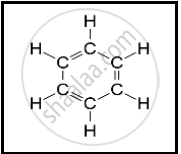
Elements Q and S react together to form an ionic compound. Under normal conditions, which physical state will the compound QS exist in?
Write the molecular formula of the given compound.
Propylene
Cation is formed when ______.
Although metals form basic oxides, which of the following metals form an amphoteric oxide?
Oils on treating with hydrogen in the presence of palladium or nickel catalyst form fats. This is an example of
State the reasons, why carbon cannot
- Lose four electrons to form C4+ cation and
- Gain four electrons to form C4- anion.
How does carbon overcome this problem to form compounds?
