Advertisements
Advertisements
Question
What is the difference between ionic compounds and polar covalent compounds?
Advertisements
Solution
Ionic compound:
- They usually have high melting points and boiling points.
- They are soluble in water. (NaCl)
- They often conduct electricity in a molten state.
- They are usually crystalline solids.
Polar covalent compound:
- Atoms do not have an equal distribution of shared electron pairs.
- They ionise in water.
- They are not electrically neutral.
- Bond is formed between dissimilar atoms such as H2O, NH3, HCl.
APPEARS IN
RELATED QUESTIONS
Ethane, with the molecular formula C2H6 has ______.
Write any three features and give two examples of covalent compounds
Why are most carbon compounds poor conductors of electricity?
Draw the electron-dot structure of the following compound and state the type of bonding in the given case:
NH3
The number of isomers formed by the hydrocarbon with molecular formula C5H12 is ______.
Give the characteristic properties of covalent compounds.
Molecular formula of Propane is C3H8 , write the structural formula of propane.
State the type of bond formed, and draw Lewis structure of water.
Write an Explanation.
Alkane
Complete the following activity.
Write the names of the hydrocarbons for the following structural formula.
(isobutylene, cyclohexane, propene, cyclohexene, cyclopentane, benzene, propyne, isobutane, propane)
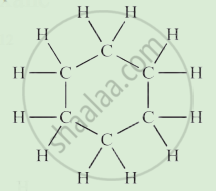 |
