Advertisements
Advertisements
Question
Draw the electron dot diagram and structure of nitrogen molecule.
Advertisements
Solution
Electron dot:
\[\begin{equation}\begin{aligned}:\text{N }\vdots\text{ + } \vdots\text{ N}: \ce{->} :\text{N }\vdots\text{ } \vdots\text{ N}:\end{aligned}\end{equation}\]
or
\[\begin{equation}\begin{aligned}:\text{N } \ce{\bond{#}\text{ N}:\\ \ce{^}\phantom{...}\\\text{Triple bond} }\end{aligned}\end{equation}\]
Molecular Formula:
N2 or N ≡ N
APPEARS IN
RELATED QUESTIONS
Name the following:
The property of element by virtue of which atoms of the element can link to each other in the form of a long chain or ring structure.
How does graphite act as a lubricant?
What type of bond is present in oxygen?
The molecules having triple bond in them are ______.
Two non-metals combine with each other by the sharing of electrons to form a compound X.
- What type of chemical bond is present in X?
- State whether X will have a high melting point or low melting point.
- Will it be a good conductor of electricity or not?
- Will it dissolve in an organic solvent or not?
The number of isomers formed by the hydrocarbon with molecular formula C5H12 is ______.
The following structural formula belongs to which carbon compound?
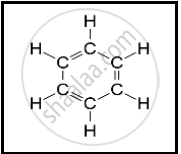
Explain the following briefly.
Pure water does not conduct electricity, but on adding sodium chloride to it, it starts conducting electricity.
Explain the following:
Polar covalent compounds are good conductors of electricity.
State the reasons, why carbon cannot
- Lose four electrons to form C4+ cation and
- Gain four electrons to form C4- anion.
How does carbon overcome this problem to form compounds?
