Advertisements
Advertisements
Question
Taking hydrogen chloride and methane as examples, distinguish between a polar covalent bond and a non polar covalent bond.
Advertisements
Solution
Hydrogen chloride has a polar covalent bond because in hydrogen chloride the higher electronegativity of chlorine atom attracts the shared electron pair towards itself. As a result, the chlorine atom gets a partial negative charge while the hydrogen atom gets a partial positive charge. Hence such a covalent bond with charge separation is called polar covalent bond.
While methane has a non polar covalent bond because in case of methane molecule the shared electron pairs are at equal distance from the carbon and hydrogen atoms, because neither the carbon atom nor the hydrogen atom has enough electronegativity difference between each other to attract the shared pairs of electrons towards itself. Hence no charge separation occurs in the covalent bond due to which it is called non polar covalent bond.
Concept Insight: When a covalent bond is formed between the atoms of the same elements of equal electronegativity then the electron pairs are shared equally between the atoms and the bond so formed is called non polar covalent bond. On the other hand, if the covalent bond is formed between atoms of different elements, with difference in electro negativity, the electrons are not shared equally between the atoms. The more electronegative atom pulls the bonded pair of electrons towards itself and acquires negative charge while the other less electro negative atom acquires positive charge and the bond becomes polar covalent bond.
APPEARS IN
RELATED QUESTIONS
Write the number of covalent bonds in the molecule of butane, C4H10.
How does graphite act as a lubricant?
What type of bond is present in methane (CH4)?
Why does carbon form compounds mainly by covalent bonding?
State any two uses of graphite.
What is the difference between ionic compounds and covalent compounds?
Draw all possible structural formulae of the compound from its molecular formula given below.
C4H10
Complete the following activity.
Write the names of the hydrocarbons for the following structural formula.
(isobutylene, cyclohexane, propene, cyclohexene, cyclopentane, benzene, propyne, isobutane, propane)
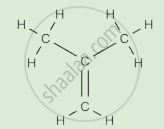 |
An element A is soft and can be cut with a knife. This is very reactive to air and cannot be kept open in air. It reacts vigorously with water. Identify the element from the following
What is a covalent bond?
