Advertisements
Advertisements
Question
Draw the electron-dot structure of H2O compound and state the type of bonding.
Advertisements
Solution
The electron-dot structure of H2O is:

The oxygen atom shares its one electron with each hydrogen atom to form a covalent bond in the water molecule.
APPEARS IN
RELATED QUESTIONS
State the reason why carbon can neither form C4+ cations nor C4− anions but forms covalent compounds.
State the reason to explain why covalent compounds "have low melting and boiling points."
What would be the electron dot structure of carbon dioxide which has the formula CO2?
Choose the most appropriate answer from the following list of oxides which fit the description.
A covalent oxide of a metalloid.
What type of bonds are present in Cl2 molecule? Draw their electron-dot structures.
Which inert gas does the H atom in HCl resemble in electron arrangement?
Draw the electron-dot structure of N2 and state the type of bonding.
The organic compound prepared by Wohler from an inorganic compound called ammonium cyanate was:
(a) glucose
(b) urea
(c) uric acid
(d) vinegar
Methane molecule is non-polar molecule. Explain.
Elements forming ionic compounds attain noble gas electronic configuration by either gaining or losing electrons from their valence shells. Explain giving reason why carbon cannot attain such a configuration in this manner to form its compounds. Name the type of bonds formed in ionic compounds and in the compounds formed by carbon. Also explain the reason why carbon compounds are generally poor conductors of electricity.
Explain the Structural isomerism term with example.
Explain the following:
Covalent compounds are generally gases or liquids or soft solids.
Explain the following:
Non-polar covalent compounds are insoluble in water.
Acids dissolve in water to produce positively charged ions. Draw the structure of these positive ions.
Number of valence electrons in a carbon atom is _______.
The bond between two oxygen atoms is _______ bond.
Complete the following activity.
Write the names of the hydrocarbons for the following structural formula.
(isobutylene, cyclohexane, propene, cyclohexene, cyclopentane, benzene, propyne, isobutane, propane)
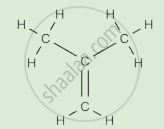 |
Which of the following is the purest form of carbon?
Carbon forms four covalent bonds by sharing its four valence electrons with four univalent atoms, e.g. hydrogen. After the formation of four bonds, carbon attains the electronic configuration of
Non-polar covalent compounds are ______ conductors of heat and electricity.
