Advertisements
Advertisements
Questions
Give two example in following case:
Solid covalent compounds
Give an example in the following case:
Solid covalent compound
Advertisements
Solution 1
Phosphoruspentachloride and diamond
Solution 2
Iodine and PCl5
APPEARS IN
RELATED QUESTIONS
State the type of bonding in the following molecule.
Water
Explain the bonding in methane molecule using electron dot structure.
Write the electron-dot structure for the following molecule:
Cl2
Why is diamond used for making cutting tools (like glass cutters) but graphite is not?
Give the formula of the compound that would be formed by the combination of the following pair of elements:
Al and Cl2
The electronic configurations of three elements X, Y and Z are as follows:
| X | 2, 4 |
| Y | 2, 7 |
| Z | 2, 1 |
- Which two elements will combine to form an ionic compound?
- Which two elements will react to form a covalent compound?
Give reasons for your choice.
Element A has 2 electrons in its M shell. Element B has atomic number 7.
- Write equations to show how A and B form ions.
- If B is a diatomic gas, write the equation for the direct combination of A and B to form a compound.
- If the compound formed between A and B is melted and an electric current is passed through the molten compound, the element A will be obtained at the ______ and B at the ______ of the electrolytic cell.
Draw the electron dot structure of the covalent compound methane (non polar) and HCl (polar) and give two difference between them.
Complete the following activity.
Write the names of the hydrocarbons for the following structural formula.
(isobutylene, cyclohexane, propene, cyclohexene, cyclopentane, benzene, propyne, isobutane, propane)
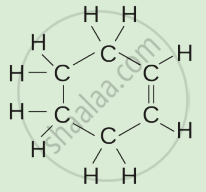 |
In covalent bond formation, the sharing of ______ electrons takes place in their outermost shell.
