Advertisements
Advertisements
Question
The atomic numbers of four elements P, Q, R and S are 6, 10, 12 and 17 respectively. Which two elements can combine to form a covalent compound?
(a) P and R
(b) Q and S
(c) P and S
(d) R and S
Advertisements
Solution
(c) P and S
Element P needs 4 electrons to complete its octet. They can be shared with element S, which needs only 1 electron to complete its octet.
APPEARS IN
RELATED QUESTIONS
What are covalent compounds?
Give reason why carbon compounds are generally poor conductors of electricity.
Give the formula of the compound that would be formed by the combination of the following pair of elements:
Al and Cl2
Draw the electron-dot structure of a hydrogen chloride molecule.
State one use of diamond which depends on its 'extraordinary brilliance' and one use of graphite which depends on its being 'black and quite soft'.
Explain why, diamond has a high melting point.
Draw an electron dot structure of the following molecule. (Without showing the circle) :
Methane
Draw an electron dot structure of the following molecule. (Without showing the circle) :
Ethene
Choose the correct answer from the options given below
Which one is not example of polar covalent compound?
Draw the electron dot diagram and structure of magnesium chloride.
Name two compounds that are covalent when taken pure but produce ions when dissolved in water.
Number of valence electrons in a carbon atom is _______.
Write scientific reason.
Benzene compounds are called aromatic compounds.
Complete the following activity.
Write the names of the hydrocarbons for the following structural formula.
(isobutylene, cyclohexane, propene, cyclohexene, cyclopentane, benzene, propyne, isobutane, propane)
| \[\begin{array}{cc} \phantom{..}\ce{H}\phantom{...}\ce{H}\phantom{...}\ce{H}\\ \phantom{..}|\phantom{....}|\phantom{....}|\\ \ce{H - C - C- C- H}\\ \phantom{.}|\phantom{....}|\phantom{....}|\\ \ce{H - C - H}\\ |\\\ce{H}\end{array}\] |
Complete the following activity.
Write the names of the hydrocarbons for the following structural formula.
(isobutylene, cyclohexane, propene, cyclohexene, cyclopentane, benzene, propyne, isobutane, propane)
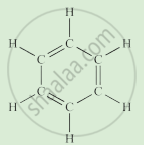 |
Complete the following activity.
Write the names of the hydrocarbons for the following structural formula.
(isobutylene, cyclohexane, propene, cyclohexene, cyclopentane, benzene, propyne, isobutane, propane)
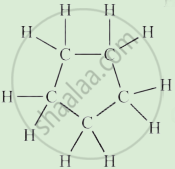 |
Two carbon atoms can always form one or two covalent bonds.
An element A is soft and can be cut with a knife. This is very reactive to air and cannot be kept open in air. It reacts vigorously with water. Identify the element from the following
A molecule of ammonia (NH3) has
Molecular reactions are ______ in the covalent compound.
