Advertisements
Advertisements
Question
Explain why, diamond can be used in rock drilling equipment but graphite cannot.
Advertisements
Solution
As diamond is extremely hard, it can be used to cut and grind other hard materials or metals. Hence, it is used in rock-drilling equipment to drill holes in the rocky layers of the Earth. Graphite being soft cannot be used to cut or grind.
APPEARS IN
RELATED QUESTIONS
Explain why carbon forms compounds mainly by covalent bond.
State the reason why carbon can neither form C4+ cations nor C4− anions but forms covalent compounds.
What type of bonds are present in methane (CH4) and sodium chloride (NaCl)?
Fill in the blank in the following sentence:
Two atoms of the same element combine to form a molecule. The bond between them is known as ................ bond.
Fill in the blank in the following sentence:
Two chlorine atoms combine to form a molecule. The bond between them is known as ..........
Friedrich Wohler converted an inorganic compound into an organic compound in the laboratory.
Write the name and formula of organic compound formed.
Draw the electron-dot structure of H2O compound and state the type of bonding.
The number of covalent bonds in pentane (molecular formula C5H12) is:
The molecules having triple bond in them are:
(a) oxygen and ethyne
(b) carbon dioxide and ammonia
(c) methane and ethene
(d) nitrogen and ethyne
The following structural formula belongs to which carbon compound?
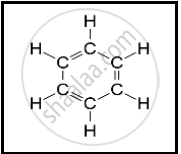
Explain the following briefly.
Pure water does not conduct electricity, but on adding sodium chloride to it, it starts conducting electricity.
Give examples for the following:
Two liquid non polar compounds.
Give examples for the following:
Two gaseous non polar compounds.
What do you understand by lone pair and shared pair?
Name the anion present in the following compound:
When a barium chloride solution is added to a solution of compound B, a white precipitate insoluble in dilute hydrochloric acid is formed.
Write an Explanation.
Alkane
Complete the following activity.
Write the names of the hydrocarbons for the following structural formula.
(isobutylene, cyclohexane, propene, cyclohexene, cyclopentane, benzene, propyne, isobutane, propane)
| \[\begin{array}{cc}\ce{H}\phantom{...}\ce{H}\phantom{...}\ce{H}\\ |\phantom{....}|\phantom{....}|\\\ce{H - C - C - C - H}\\ |\phantom{....}|\phantom{....}|\\\ce{H}\phantom{...}\ce{H}\phantom{...}\ce{H} \end{array}\] |
Which of the following statements are correct for carbon compounds?
- Most carbon compounds are good conductors of electricity.
- Most carbon compounds are poor conductors of electricity.
- Force of attraction between molecules of carbon compounds is not very strong.
- Force of attraction between molecules of carbon compounds is very strong.
