Advertisements
Advertisements
Question
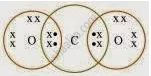
What would be the electron dot structure of carbon dioxide which has the formula CO2?
Advertisements
Solution

APPEARS IN
RELATED QUESTIONS
Explain the bonding in methane molecule using electron dot structure.
What type of bonds are present in hydrogen chloride and oxygen?
Describe the structure of diamond. Draw a simple diagram to show the arrangement of carbon atoms in diamond.
Two non-metals combine with each other by the sharing of electrons to form a compound X.
(a) What type of chemical bond is present in X?
(b) State whether X will have a high melting point or low melting point.
(c) Will it be a good conductor of electricity or not?
(d) Will it dissolve in an organic solvent or not?
The pencil leads are made of mainly:
(a) lithium
(b) charcoal
(c) lead
(d) graphite
What do you understand by polar covalent compounds?
State the type of bonding in the following molecule.
Water
Give two example in following case:
Solid covalent compounds
Choose the correct answer from the options given below
Which one is not example of polar covalent compound?
The electronic configuration of N2 is 2, 5. How many electrons in the outer shell of a N atom are not involved in the formation of a nitrogen molecule?
State the type of bonding in the following molecule.
Water
Explain the following:
Water is a polar covalent molecule.
Name two compounds that are covalent when taken pure but produce ions when dissolved in water.
Explain the following:
Polar covalent compounds conduct electricity?
The bond between two oxygen atoms is _______ bond.
Your body is made up of carbon.
Complete the following activity.
Write the names of the hydrocarbons for the following structural formula.
(isobutylene, cyclohexane, propene, cyclohexene, cyclopentane, benzene, propyne, isobutane, propane)
| \[\begin{array}{cc}\phantom{......}\ce{H}\phantom{...}\ce{H}\phantom{...}\ce{H}\phantom{..}\\ \phantom{.....}|\phantom{....}|\phantom{....}|\\ \ce{H - C - C = C}\\\phantom{.....}|\phantom{.........}|\\ \phantom{.....}\ce{H}\phantom{........}\ce{H}\end{array}\] |
Complete the following activity.
Write the names of the hydrocarbons for the following structural formula.
(isobutylene, cyclohexane, propene, cyclohexene, cyclopentane, benzene, propyne, isobutane, propane)
| \[\begin{array}{cc}\ce{H}\phantom{...}\ce{H}\phantom{...}\ce{H}\\ |\phantom{....}|\phantom{....}|\\\ce{H - C - C - C - H}\\ |\phantom{....}|\phantom{....}|\\\ce{H}\phantom{...}\ce{H}\phantom{...}\ce{H} \end{array}\] |
Mineral acids are stronger acids than carboxylic acids because
- mineral acids are completely ionised
- carboxylic acids are completely ionised
- mineral acids are partially ionised
- carboxylic acids are partially ionised