Advertisements
Advertisements
Question
Give appropriate scientific reasons for Carbon tetrachloride does not conduct electricity.
Advertisements
Solution
Carbon tetrachloride is made of individual covalently bonded molecules, CCl4. In addition, the charged particles are absent in CCl4 which could conduct electricity. So, CCl4 does not conduct electricity
APPEARS IN
RELATED QUESTIONS
What are covalent compounds?
What would be the electron dot structure of a molecule of sulphur which is made up of eight atoms of sulphur? (Hint – the eight atoms of sulphur are joined together in the form of a ring.)
Name the element whose one of the allotropic forms is buckminsterfullerene.
Why is diamond used for making cutting tools (like glass cutters) but graphite is not?
Explain why, diamond is hard while graphite is soft (though both are made of carbon atoms).
Give the formulae of the chlorides of the elements X and Y having atomic numbers of 3 and 6 respectively. Will the properties of the two chlorides be similar or different? Explain your answer.
Complete the following:
In case of non-polar covalent bond, the covalent bond is formed in the ______ of atoms and shared electrons are ______ distributed. (corner, middle, equally, unequally)
Element A has 2 electrons in its M shell. Element B has atomic number 7.
- Write equations to show how A and B form ions.
- If B is a diatomic gas, write the equation for the direct combination of A and B to form a compound.
- If the compound formed between A and B is melted and an electric current is passed through the molten compound, the element A will be obtained at the ______ and B at the ______ of the electrolytic cell.
Complete the following activity.
Write the names of the hydrocarbons for the following structural formula.
(isobutylene, cyclohexane, propene, cyclohexene, cyclopentane, benzene, propyne, isobutane, propane)
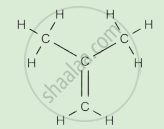 |
Mineral acids are stronger acids than carboxylic acids because
- mineral acids are completely ionised
- carboxylic acids are completely ionised
- mineral acids are partially ionised
- carboxylic acids are partially ionised
