Advertisements
Advertisements
प्रश्न
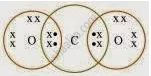
What would be the electron dot structure of carbon dioxide which has the formula CO2?
Advertisements
उत्तर

APPEARS IN
संबंधित प्रश्न
State the reason why carbon can neither form C4+ cations nor C4− anions but forms covalent compound.
Why are most carbon compounds poor conductors of electricity?
Which inert gas does the H atom in HCl resemble in electron arrangement?
Draw the electron-dot structure of CO2 compound and state the type of bonding.
Draw the electron-dot structure of NH3 and state the type of bonding.
Write two points of difference in the structures of diamond and graphite.
Why is graphite a good conductor of electricity but diamond is a non-conductor of electricity?
A hydrocarbon having one double bond has 100 carbon atoms in its molecule. The number of hydrogen atoms in its molecule will be
(a) 200
(b) 198
(c) 202
(d) 196
The pencil leads are made of mainly:
(a) lithium
(b) charcoal
(c) lead
(d) graphite
Explain the following briefly:
Cl2 is a non polar molecule, while HCl is a polar molecule.
Give examples for the following:
Two gaseous non polar compounds.
(a) Compound X consists of molecules.
Choose the letter corresponding to the correct answer from the choices (a), (b), (c) and (d) given below
X is likely to have a :
Give reason as to why hydrogen chloride can be termed as a polar covalent compound.
Explain the following:
Water is a polar covalent molecule.
Define the functional group and complete the following table.
| S.I. No. | Functional Group | Compound | Formula |
| (1) | ______________ | _______________ |
C2H5OH |
| (2) | _______________ | _______________ | CH3CHO |
From the following hydrocarbon _______ is the cyclic hydrocarbon.
Your body is made up of carbon.
Give an example for each of the following statement.
Formation of coordinate covalent bond between NH3 ➝ BF3 molecules
An element A is soft and can be cut with a knife. This is very reactive to air and cannot be kept open in air. It reacts vigorously with water. Identify the element from the following
Mineral acids are stronger acids than carboxylic acids because
- mineral acids are completely ionised
- carboxylic acids are completely ionised
- mineral acids are partially ionised
- carboxylic acids are partially ionised