Advertisements
Advertisements
प्रश्न
Draw the electron-dot structure of HCl compound and state the type of bonding.
Advertisements
उत्तर
The electron-dot structure of HCl is:

The hydrogen atom shares its one electron with a chlorine atom to form a covalent bond.
APPEARS IN
संबंधित प्रश्न
Elements forming ionic compounds attain noble gas configuration by either gaining or losing electrons from their outermost shells. Give reason to explain why carbon cannot attain noble gas configuration in this manner to form its compounds.
State the reason why carbon can neither form C4+ cations nor C4− anions but forms covalent compounds.
What type of bonds are present in water molecule? Draw the electron-dot structure of water (H2O).
Fill in the blank in the following sentence:
Two chlorine atoms combine to form a molecule. The bond between them is known as ..........
Give one example, state what are covalent compounds?
Compare the properties of ionic compounds and covalent compounds.
Name one covalent compound containing chlorine.
State one use of diamond which depends on its 'extraordinary brilliance' and one use of graphite which depends on its being 'black and quite soft'.
Which element exhibits the property of catenation to maximum extent and why?
Give examples for the following:
Two gaseous polar compounds.
Explain the structure of Ammonium ion.
(a) Compound X consists of molecules.
Choose the letter corresponding to the correct answer from the choices (a), (b), (c) and (d) given below
The type of bonding in X will be
Compound X consists of molecules.
Choose the letter corresponding to the correct answer from the options A, B, C and D given below:
X is likely to have a ______.
Electrons are getting added to an element Y:
which electrode will Y migrate to during the process of electrolysis?
Potassium (Atomic No. 19) and chlorine (Atomic No. 17) react to form a compound. On the basis of electronic concept, explain
(i) oxidation
(ii) reduction
(iii)oxidising agent
(iv)reducing agent
Define a covalent bond.
Complete the following activity.
Write the names of the hydrocarbons for the following structural formula.
(isobutylene, cyclohexane, propene, cyclohexene, cyclopentane, benzene, propyne, isobutane, propane)
| \[\begin{array}{cc} \phantom{..}\ce{H}\phantom{...}\ce{H}\phantom{...}\ce{H}\\ \phantom{..}|\phantom{....}|\phantom{....}|\\ \ce{H - C - C- C- H}\\ \phantom{.}|\phantom{....}|\phantom{....}|\\ \ce{H - C - H}\\ |\\\ce{H}\end{array}\] |
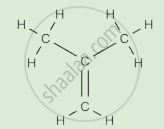
Complete the following activity.
Write the names of the hydrocarbons for the following structural formula.
(isobutylene, cyclohexane, propene, cyclohexene, cyclopentane, benzene, propyne, isobutane, propane)
 |
When ethyl alcohol and acetic acid are mixed, the resulting ester has a chemical formula ______.
