Advertisements
Advertisements
प्रश्न
Compound X consists of molecules.
Choose the letter corresponding to the correct answer from the options A, B, C and D given below:
X is likely to have a ______.
विकल्प
low melting point and high boiling point.
high melting point and low boiling point.
low melting point and low boiling point.
high melting point and high boiling point.
Advertisements
उत्तर
X is likely to have a low melting point and low boiling point.
APPEARS IN
संबंधित प्रश्न
Name the following:
The property of element by virtue of which atoms of the element can link to each other in the form of a long chain or ring structure.
Complete the following:
In case of non-polar covalent bond, the covalent bond is formed in the ______ of atoms and shared electrons are ______ distributed. (corner, middle, equally, unequally)
Give two example in following case:
Gaseous non polar covalent compound.
Elements forming ionic compounds attain noble gas electronic configuration by either gaining or losing electrons from their valence shells. Explain giving reason why carbon cannot attain such a configuration in this manner to form its compounds. Name the type of bonds formed in ionic compounds and in the compounds formed by carbon. Also explain the reason why carbon compounds are generally poor conductors of electricity.
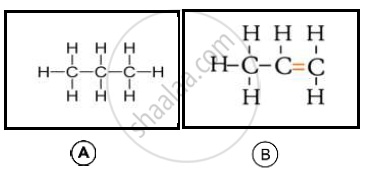
Observe the straight chain hydrocarbons given below and answer the following
questions :
i) Which of the straight chain compounds from A and B is saturated and unsaturated straight chains?
ii) Name these straight chains.
iii) Write their chemical formulae and number of – CH2 - units.
The carbon compound is used in daily life is ______.
Give the appropriate term defined by the statement given below:
The covalent bond in which the electrons are shared equally between the combining atoms.
Taking MgCl2 as an electrovalent compound, CCl4 as a covalent compound, give four difference between electrovalent and covalent compounds
Although metals form basic oxides, which of the following metals form an amphoteric oxide?
The table shows the electronic structures of four elements.
| Element | Electronic Structure |
| P | 2, 6 |
| Q | 2, 8, 1 |
| R | 2, 8, 7 |
| S | 2, 8, 8 |
- Identify which element(s) will form covalent bonds with carbon.
- “Carbon reacts with an element in the above table to form several compounds.” Give suitable reason.
