Advertisements
Advertisements
प्रश्न
Give one example, state what are covalent compounds?
Advertisements
उत्तर
Covalent compounds are compounds that are formed by the sharing of electrons between two or more atoms.
Example: Hydrogen (H2) is a covalent compound, where each hydrogen atom shares one electron to form a stable compound.
APPEARS IN
संबंधित प्रश्न
Name the type of bonds formed in ionic compounds and in the compounds formed by carbon.
What type of bonds are present in hydrogen chloride and oxygen?
What type of chemical bonds are formed by carbon? Why?
Which inert gas does the H atom in HCl resemble in electron arrangement?
Which inert gas does the Cl atom in HCl resemble in electron arrangement?
Describe the structure of graphite with the help of a labelled diagram.
One of the following contains a double bond as well as single bonds. This is:
(a) CO2
(b) O2
(c) C2H4
(d) C2H2
One of the following is not an allotrope of carbon. This is:
(a) diamond
(b) graphite
(c) cumene
(d) buckministerfullerene
What happens when methane (natural gas) burns in air? Write the chemical equation of the reaction involved.
Complete the following:
In case of non-polar covalent bond, the covalent bond is formed in the ______ of atoms and shared electrons are ______ distributed. (corner, middle, equally, unequally)
Draw an electron dot structure of the following molecule. (Without showing the circle) :
Methane
Draw an electron dot structure of the following molecule. (Without showing the circle) :
Methanol
Write answer as directed.
What causes the existance of very large number of carbon compound ?
Taking hydrogen chloride and methane as examples, distinguish between a polar covalent bond and a non polar covalent bond.
Choose the correct answer from the options given below
Condition favorable for formation of a covalent bond is
What is the term defined below?
A bond formed by a shared pair of electrons, each bonding atom contributing one electron to the pair.
Potassium chloride is an electrovalent compound, while hydrogen chloride is a covalent compound, But, both conduct electricity in their aqueous solutions. Explain.
Complete the following activity.
Write the names of the hydrocarbons for the following structural formula.
(isobutylene, cyclohexane, propene, cyclohexene, cyclopentane, benzene, propyne, isobutane, propane)
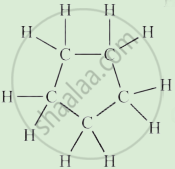 |
The bond which is formed by the mutual sharing of electrons is called ______ bond.
