Advertisements
Advertisements
प्रश्न
What happens when methane (natural gas) burns in air? Write the chemical equation of the reaction involved.
Advertisements
उत्तर
When methane (natural gas) burns in air, carbon dioxide and water vapour are formed along with the release of a large amount of heat. This process is known as combustion.
APPEARS IN
संबंधित प्रश्न
Write structural formula of Methane.
Butanone is a four-carbon compound with the functional group:
State whether the following statement is true or false:
Diamond and graphite are the covalent compounds of carbon element (C).
Name a carbon containing molecule which has two double bonds.
What type of bond is present in the following molecule?
Cl2
Give one example of the following:
A molecule containing a single covalent bond.
Give one example of the following:
A molecule containing a triple covalent bond.
Explain the formation of a chlorine molecule on the basis of electronic theory of valency.
Compare the properties of ionic compounds and covalent compounds.
Give two general properties of ionic compounds.
Explain why, diamond can be used in rock drilling equipment but graphite cannot.
Explain why, diamond has a high melting point.
Out of KCl, HCl, CCl4 and NaCl, the compounds which are not ionic are:
The molecules having triple bond in them are ______.
The electronic configurations of three elements X, Y and Z are as follows:
| X | 2, 4 |
| Y | 2, 7 |
| Z | 2, 1 |
- Which two elements will combine to form an ionic compound?
- Which two elements will react to form a covalent compound?
Give reasons for your choice.
Which of the following cannot exhibit isomerism?
The number of carbon atoms joined in a spherical molecule of buckminsterfullerene is ______.
Explain the following:
polar covalent compounds electricity.
State the type of bonding in the following molecule.
Hydroxyl ion
State the type of bonding in the following molecule.
Ammonium ion
Draw all possible structural formulae of the compound from its molecular formula given below.
C3H8
Explain the following term with example.
Alkane
Explain the following:
Covalent compounds have low melting and boiling point.
Choose the correct answer from the options given below
Which one is not example of polar covalent compound?
Fill in the blank with correct word from the bracket.
Melting and boiling points of covalent compounds are generally ______ (low, high).
The molecule which contains a triple covalent bond is ______.
Explain the bonding in methane molecule using electron dot structure.
An element L consists of molecules.
Why L is heated with iron metal, it forms a compound FeL. What chemical term would you use to describe the change undergone by L?
State the type of bonding in the following molecule.
Water
Elements Q and S react together to form an ionic compound. Under normal conditions, which physical state will the compound QS exist in?
Explain the following:
Polar covalent compounds conduct electricity?
Taking MgCl2 as an electrovalent compound, CCl4 as a covalent compound, give four difference between electrovalent and covalent compounds
Complete the following activity.
Write the names of the hydrocarbons for the following structural formula.
(isobutylene, cyclohexane, propene, cyclohexene, cyclopentane, benzene, propyne, isobutane, propane)
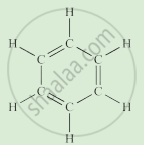 |
Complete the following activity.
Write the names of the hydrocarbons for the following structural formula.
(isobutylene, cyclohexane, propene, cyclohexene, cyclopentane, benzene, propyne, isobutane, propane)
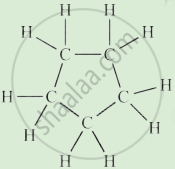 |
Give an example for each of the following statement.
Formation of coordinate covalent bond between NH3 ➝ BF3 molecules
Which of the following are correct structural isomers of butane?
- \[\begin{array}{cc}
\ce{H}\phantom{...}\ce{H}\phantom{...}\ce{H}\phantom{...}\ce{H}\\
|\phantom{....}|\phantom{....}|\phantom{....}|\\
\ce{H - C - C - C - C - H}\\
|\phantom{....}|\phantom{....}|\phantom{....}|\\
\ce{H}\phantom{...}\ce{H}\phantom{...}\ce{H}\phantom{...}\ce{H}\\
\end{array}\] - \[\begin{array}{cc}
\ce{H}\phantom{...}\ce{H}\phantom{...}\ce{H}\\
|\phantom{....}|\phantom{....}|\\
\ce{H - C - C - C - H}\\
|\phantom{.....}|\phantom{.....}|\\
\ce{H}\ce{H-C-H}\ce{H}\\
|\\
\ce{H}\\
\end{array}\] - \[\begin{array}{cc}
\ce{H}\phantom{...}\ce{H}\phantom{...}\ce{H}\\
|\phantom{....}|\phantom{....}|\\
\ce{H - C - C - C - H}\\
|\phantom{.....}\backslash\phantom{..}|\\
\phantom{....}\ce{H}\phantom{......}\ce{C - H}\phantom{}\\
\phantom{.......}|\\
\phantom{.......}\ce{H}\\
\end{array}\] - \[\begin{array}{cc}
\ce{H}\phantom{...}\ce{H}\\
|\phantom{....}|\\
\ce{H - C - C - H}\\
|\phantom{....}|\\
\ce{H - C - C - H}\\
|\phantom{....}|\\
\ce{H}\phantom{...}\ce{H}\\
\end{array}\]
The number of single and double bonds present in a molecule of benzene (C6H6) respectively, are ______.
