Advertisements
Advertisements
प्रश्न
A solid element X has four electrons in the outermost shell of its atom. An allotrope Y of this element is used as a dry lubricant in machinery and also in making pencil leads.
(a) What is element X?
(b) Name the allotrope Y.
(c) State whether allotrope Y is a good conductor or non-conductor of electricity.
(d) Name one use of allotrope Y (other than lubrication and pencil leads)
(e) Name two other allotropes of element X.
Advertisements
उत्तर
(a) The solid element 'X' is carbon, which has four electrons in the outermost shell of its atom.
(b) Graphite is the allotrope 'Y' of carbon which is used as a dry lubricant in machinery, and al in making pencil leads.
(c) Graphite (Y) is a good conductor of electricity because of the presence of free electrons in its crystal.
(d) Graphite (Y) is used in making carbon electrodes or graphite electrodes in dry cells and electric arcs.
(e) Diamond and buckminsterfullerene are the two other allotropes of carbon.
APPEARS IN
संबंधित प्रश्न
Why covalent compounds are different from ionic compounds?
What type of bonds are present in methane (CH4) and sodium chloride (NaCl)?
What type of bonds are present in Cl2 molecule? Draw their electron-dot structures.
Give one example of a molecule containing a triple covalent bond.
What type of bond exist in CCl4?
Draw the electron-dot structure of H2O compound and state the type of bonding.
Buckminsterfullerene is an allotropic form of the element:
(a) phoshorus
(b) fluorine
(c) carbon
(d) sulphur
A saturated hydrocarbon has fifty hydrogen atom in its molecule. The number of carbon atoms in its molecule will be
(a) twenty five
(b) twenty four
(c) twenty six
(d) twenty seven
Complete the following:
In case of non-polar covalent bond, the covalent bond is formed in the ______ of atoms and shared electrons are ______ distributed. (corner, middle, equally, unequally)
Match the pairs.
| Group 'A' | Group 'B' |
| a. C2H6 | 1. Unsaturated hydrocarbon |
| b. C2H2 | 2. Molecular formula of an alcohol |
| c. CH4O | 3. Saturated hydrocarbon |
| d. C3H6 | 4. Triple bond |
Explain the following term with example.
Covalent bond
The following structural formula belongs to which carbon compound?
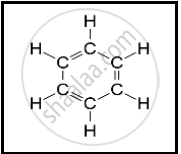
Explain the following:
Covalent compounds are generally gases or liquids or soft solids.
What is the term defined below?
A bond formed by a shared pair of electrons, each bonding atom contributing one electron to the pair.
Complete the following activity.
Write the names of the hydrocarbons for the following structural formula.
(isobutylene, cyclohexane, propene, cyclohexene, cyclopentane, benzene, propyne, isobutane, propane)
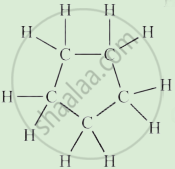 |
Give an example for each of the following statement.
Formation of coordinate covalent bond between NH3 ➝ BF3 molecules
Identify the incorrect statement and correct them.
- Like covalent compounds, coordinate compounds also contain charged particles (ions). So they are good conductors of electricity.
- Ionic bond is a weak bond when compared to Hydrogen bond.
- Ionic or electrovalent bonds are formed by mutual sharing of electrons between atoms.
- Loss of electrons is called Oxidation and gain of electron is called Reduction.
- The electrons which are not involved in bonding are called valence electrons.
The bond which is formed by the mutual sharing of electrons is called ______ bond.
Explain dipole (polar) molecule by taking hydrogen chloride as an example.
