Advertisements
Advertisements
प्रश्न
What are the conditions necessary for the formation of covalent molecules?
What are the conditions required for the formation of a covalent bond?
Advertisements
उत्तर १
Covalent bond is formed when the participating atoms contribute one electron each to form an electron pair which is then shared by the participating atoms in such a manner that each atom attains the nearest noble gas configuration.
Each atom should not be completely filled before covenant bond formation.
उत्तर २
- Both atoms should have high electron affinity.
- Both atoms should have high ionization energy.
- Both atoms should have four or more electrons in their valence shells.
- Both atoms should have high electronegativity.
Notes
Students can refer to the provided solutions based on their preferred marks.
संबंधित प्रश्न
Elements forming ionic compounds attain noble gas configuration by either gaining or losing electrons from their outermost shells. Give reason to explain why carbon cannot attain noble gas configuration in this manner to form its compounds.
What type of bonds are present in a water molecule?
Name one covalent compound containing chlorine.
Explain why, diamond is hard while graphite is soft (though both are made of carbon atoms).
Give the formulae of the chlorides of the elements X and Y having atomic numbers of 3 and 6 respectively. Will the properties of the two chlorides be similar or different? Explain your answer.
The following structural formula belongs to which carbon compound?
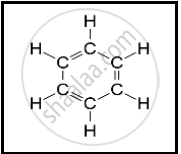
Taking hydrogen chloride and methane as examples, distinguish between a polar covalent bond and a non polar covalent bond.
The following table shows the electronic configuration of the elements W, X, Y, Z:
|
Element |
W |
X |
Y |
Z |
|
Electronic |
2,8,1 |
2,8,7 |
2,5 |
1 |
Answer the following questions based on the table above:
What type of bond is formed between Y and Z.
Element A has 2 electrons in its M shell. Element B has atomic number 7.
Write equations to show how A and B form ions.
Non-polar covalent compounds are ______ conductors of heat and electricity.
