Advertisements
Advertisements
प्रश्न
Explain the structure of Ammonium ion.
Advertisements
उत्तर
Structure of Ammonium ion: Ammonium ion (NH4+) is formed when a hydrogen ion or proton combines with ammonia molecule. Nitrogen atom in ammonia has a lone pair of electrons on it which it shares with the hydrogen ion which tends to acquire the configuration of helium atom. Thus, a co-ordinate bond results between nitrogen atom and hydrogen ion in ammonium ion.
APPEARS IN
संबंधित प्रश्न
Write the number of covalent bonds in the molecule of butane, C4H10.
Name the following:
The property of element by virtue of which atoms of the element can link to each other in the form of a long chain or ring structure.
What type of bond is present in the following molecule?
CH4
The molecules having triple bond in them are ______.
Explain the following term with an example.
Unsaturated hydrocarbon
(a) Compound X consists of molecules.
Choose the letter corresponding to the correct answer from the choices (a), (b), (c) and (d) given below
The type of bonding in X will be
Covalent bonds can be single, double or triple covalent bonds. How many electrons are shared in each? Give an example of each type.
Complete the following activity.
Write the names of the hydrocarbons for the following structural formula.
(isobutylene, cyclohexane, propene, cyclohexene, cyclopentane, benzene, propyne, isobutane, propane)
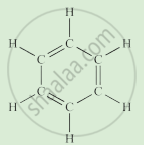 |
Give an example for each of the following statement.
A compound in which three covalent bonds are formed.
Which of the following statements are usually correct for carbon compounds? These
- are good conductors of electricity
- are poor conductors of electricity
- have strong forces of attraction between their molecules
- do not have strong forces of attraction between their molecules.
