Advertisements
Advertisements
प्रश्न
Explain the structure of Hydronium ion.
Advertisements
उत्तर
Structure of hydronium ion: Hydronium ions (H3O+) are formed when a hydrogen ion released from acid combines with water molecules.
Oxygen atom in water molecule attains an octet by forming two single covalent bonds with two hydrogen atoms but it still contains two lone pairs of electrons.
H3O+ is formed when the oxygen atom in water molecule donates a lone pair of electrons to a hydrogen ion thus establishing a coordinate bond between the oxygen atom and the hydrogen ion.
APPEARS IN
संबंधित प्रश्न
In forming oxygen molecule, ______ electrons are shared by each atom of oxygen.
Draw the electron-dot structure of the following compound and state the type of bonding in the given case:
N2
Draw an electron dot structure of the following molecule. (Without showing the circle) :
Ethene
Fill in the blank with correct word from the bracket.
Melting and boiling points of covalent compounds are generally ______ (low, high).
Draw the electron dot diagram and structure of methane.
Name two compounds that are covalent when taken pure but produce ions when dissolved in water.
Answer the following question.
What is methane? Draw its electron dot structure. Name the type of bonds formed in this compound. Why are such compounds:
(i) poor conductors of electricity? and
(ii) have low melting and boiling points? What happens when this compound burns in oxygen?
Complete the following activity.
Write the names of the hydrocarbons for the following structural formula.
(isobutylene, cyclohexane, propene, cyclohexene, cyclopentane, benzene, propyne, isobutane, propane)
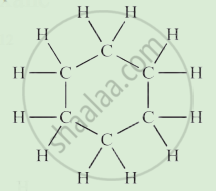 |
Two carbon atoms can always form one or two covalent bonds.
What is a covalent bond?
