Advertisements
Advertisements
Question
Explain the structure of Ammonium ion.
Advertisements
Solution
Structure of Ammonium ion: Ammonium ion (NH4+) is formed when a hydrogen ion or proton combines with ammonia molecule. Nitrogen atom in ammonia has a lone pair of electrons on it which it shares with the hydrogen ion which tends to acquire the configuration of helium atom. Thus, a co-ordinate bond results between nitrogen atom and hydrogen ion in ammonium ion.
APPEARS IN
RELATED QUESTIONS
State one major difference between covalent and ionic bonds.
What type of chemical bonds are formed by carbon? Why?
Which inert gas does the H atom in HCl resemble in electron arrangement?
Explain why, graphite can be used as a lubricant but diamond cannot.
A solid element X has four electrons in the outermost shell of its atom. An allotrope Y of this element is used as a dry lubricant in machinery and also in making pencil leads.
(a) What is element X?
(b) Name the allotrope Y.
(c) State whether allotrope Y is a good conductor or non-conductor of electricity.
(d) Name one use of allotrope Y (other than lubrication and pencil leads)
(e) Name two other allotropes of element X.
What is the term defined below?
A bond formed by a shared pair of electrons, each bonding atom contributing one electron to the pair.
What are the term defined below?
A bond formed by share pair of electrons, each bonding atom contributing one electron to the pair.
State the type of bond formed, and draw Lewis structure of water.
Write the molecular formula of the given compound.
Acetic acid
Complete the following activity.
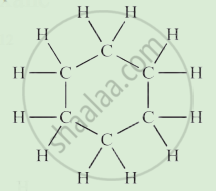
Write the names of the hydrocarbons for the following structural formula.
(isobutylene, cyclohexane, propene, cyclohexene, cyclopentane, benzene, propyne, isobutane, propane)
 |
