Advertisements
Advertisements
प्रश्न
Give one example of a molecule containing a single covalent bond.
Advertisements
उत्तर
A molecule containing a single covalent bond: hydrogen molecule (H − H)
APPEARS IN
संबंधित प्रश्न
Write structural formula of Methane.
What type of bonds are present in CH4 molecule? Draw their electron-dot structures.
Why does carbon form compounds mainly by covalent bonding?
What type of chemical bond is present in chlorine molecule? Explain your answer.
Explain why, ionic compounds conduct electricity in solution whereas covalent compounds do not conduct electricity.
Draw the electron-dot structure of NH3 and state the type of bonding.
The pencil leads are made of mainly:
(a) lithium
(b) charcoal
(c) lead
(d) graphite
State the type of bonding in the following molecule.
Water
Explain the following:
Covalent compounds have low melting and boiling point.
The electronic configuration of N2 is 2, 5. How many electrons in the outer shell of a N atom are not involved in the formation of a nitrogen molecule?
Fill in the blank from the choice given in bracket.
The compound that does not have a lone pair of electrons is ___________. (Water, Ammonia, carbon tetrachloride)
Draw an electron dot diagram to show the formation of the following compound.
Methane
Name two compounds that are covalent when taken pure but produce ions when dissolved in water.
The number of electrons in the valence shell of a carbon atom is 4.
Write scientific reason.
Carbon has the property of forming many compounds.
Complete the following activity.
Write the names of the hydrocarbons for the following structural formula.
(isobutylene, cyclohexane, propene, cyclohexene, cyclopentane, benzene, propyne, isobutane, propane)
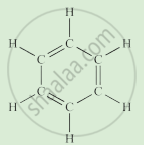 |
Cation is formed when ______.
Carbon forms four covalent bonds by sharing its four valence electrons with four univalent atoms, e.g. hydrogen. After the formation of four bonds, carbon attains the electronic configuration of
Statement (A): Covalent compounds are bad conductors of electricity.
Reason (B): Covalent compounds contain charged particles (ions)
State the reasons, why carbon cannot
- Lose four electrons to form C4+ cation and
- Gain four electrons to form C4- anion.
How does carbon overcome this problem to form compounds?
