Advertisements
Advertisements
प्रश्न
Give one example of a molecule containing a single covalent bond.
Advertisements
उत्तर
A molecule containing a single covalent bond: hydrogen molecule (H − H)
APPEARS IN
संबंधित प्रश्न
Write the number of covalent bonds in the molecule of butane, C4H10.
Choose the most appropriate answer from the following list of oxides which fit the description.
A covalent oxide of a metalloid.
Which inert gas does the Cl atom in HCl resemble in electron arrangement?
Explain why, diamond is hard while graphite is soft (though both are made of carbon atoms).
Describe the structure of graphite with the help of a labelled diagram.
One of the following is not an allotrope of carbon. This is:
(a) diamond
(b) graphite
(c) cumene
(d) buckministerfullerene
A saturated hydrocarbon has fifty hydrogen atom in its molecule. The number of carbon atoms in its molecule will be
(a) twenty five
(b) twenty four
(c) twenty six
(d) twenty seven
Which element exhibits the property of catenation to maximum extent and why?
(a) Compound X consists of molecules.
Choose the letter corresponding to the correct answer from the choices (a), (b), (c) and (d) given below
In the liquid state, X will
What is the term defined below?
A bond formed by a shared pair of electrons, each bonding atom contributing one electron to the pair.
Compound X consists of molecules.
Choose the letter corresponding to the correct answer from the options A, B, C and D given below:
X is likely to have a ______.
Name two compounds that are covalent when taken pure but produce ions when dissolved in water.
Potassium chloride is an electrovalent compound, while hydrogen chloride is a covalent compound, But, both conduct electricity in their aqueous solutions. Explain.
Fill in the blank and rewrite the completed statement:
Covalent compounds are generally soluble in _________ solvents.
The bond between two oxygen atoms is _______ bond.
Complete the following activity.
Write the names of the hydrocarbons for the following structural formula.
(isobutylene, cyclohexane, propene, cyclohexene, cyclopentane, benzene, propyne, isobutane, propane)
| \[\begin{array}{cc}\phantom{......}\ce{H}\phantom{...}\ce{H}\phantom{...}\ce{H}\phantom{..}\\ \phantom{.....}|\phantom{....}|\phantom{....}|\\ \ce{H - C - C = C}\\\phantom{.....}|\phantom{.........}|\\ \phantom{.....}\ce{H}\phantom{........}\ce{H}\end{array}\] |
Complete the following activity.
Write the names of the hydrocarbons for the following structural formula.
(isobutylene, cyclohexane, propene, cyclohexene, cyclopentane, benzene, propyne, isobutane, propane)
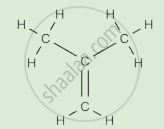 |
Give an example for each of the following statement.
Formation of coordinate covalent bond between NH3 ➝ BF3 molecules
Consider the coordination compound, K2[Cu(CN)4]. A coordinate covalent bond exists between:
The correct structural formula of butanoic acid is -
