Advertisements
Advertisements
प्रश्न
Potassium chloride is an electrovalent compound, while hydrogen chloride is a covalent compound, But, both conduct electricity in their aqueous solutions. Explain.
Advertisements
उत्तर
Potassium chloride is an electrovalent compound and conducts electricity in the molten or aqueous state because the electrostatic forces of attraction weaken in the fused state or in aqueous solution.
Polar covalent compounds like hydrogen chloride ionise in their solutions and can act as an electrolyte. So, both can conduct electricity in their aqueous solutions.
APPEARS IN
संबंधित प्रश्न
State the reason why carbon can neither form C4+ cations nor C4− anions but forms covalent compounds.
Name the element whose one of the allotropic forms is buckminsterfullerene.
What type of chemical bond is formed between:
Carbon and bromine
What type of bond is present in oxygen?
Compare the properties of ionic compounds and covalent compounds.
What are the conditions necessary for the formation of covalent molecules?
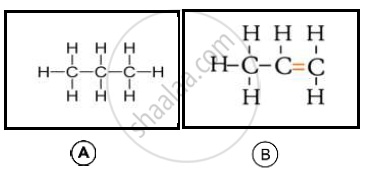
Observe the straight chain hydrocarbons given below and answer the following
questions :
i) Which of the straight chain compounds from A and B is saturated and unsaturated straight chains?
ii) Name these straight chains.
iii) Write their chemical formulae and number of – CH2 - units.
Explain the following briefly:
Sodium chloride dissolves in water but carbon tetra chloride is insoluble in water.
Explain the structure of Ammonium ion.
The bond which is formed by the mutual sharing of electrons is called ______ bond.
