Topics
Periodic Table, Periodic Properties and Variations of Properties
- Modern Periodic Table
- Salient Features of the Modern Periodic Table
- Periodicity
- Shells and Valency
- Periodic Properties
- Atomic Size
- Metallic Character
- Non-metallic Character
- Ionisation Potential (Ionisation Energy)
- Electron Affinity
- Electronegativity
- Summary Periodic Properties
- Atomic Number and Mass Number
- Comparison of Alkali Metals and Halogens
Chemical Bonding
- Concept of Chemical Bonding
- Ionic or Electrovalent Bond
- Conditions for the Formation of an Electrovalent (or ionic) Bond
- Structures of Some Electrovalent Compounds
- The Covalent Bond
- Types of Covalent Bonds
- Non-Polar and Polar Covalent Compounds
- Formation of Covalent Bond
- Properties and Comparison of Electrovalent and Covalent Compounds
- Effect of Electricity on Electrovalent and Covalent Compounds
- Coordinate Bond
Study of Acids, Bases and Salts
Acids and Bases
- Basics of Acids, Bases, and Salts
- Acids
- Classification of Acids
- Preparation of Acids
- Properties of Acids > Physical Properties
- Properties of Acids > Chemical Properties
- Uses of Acids
- Bases
- Classification of Bases (Alkalis)
- Preparation of Bases
- Properties of Bases > Physical Properties
- Properties of Bases > Chemical Properties
- Uses of Bases
- Test for Acidity and Alkalinity
- Importance of pH in Everyday Life
Salts and their Preparations
Properties of Salts
- General Properties of Salts
- Differences Between Drying Agent and Dehydrating Agent
Analytical Chemistry
- Chemical Analysis
- Colours of the Salts and Their Solutions
- Action of Sodium Hydroxide Solution on Certain Metallic Salt Solutions
- Action of Ammonium Hydroxide on Certain Salt Solutions
- Action of Alkalis on Certain Metals
- Action of Alkalis on Metal Oxides
Mole Concept and Stoichiometry
Gay-Lussac's Law and Avogadro's Law
Relative Atomic Mass, Relative Molecular Mass and Mole Concept
Percentage Composition, Empirical and Molecular Formulae
Calculations Based on Chemical Equations
- Problems Based On Reacting Weights
- Problems Based on Mass-Volume Relationship
- Challenging Problems Beyond the Syllabus
Electrolysis
- Electrolysis and Conductivity of Substances
- Metallic Conductors and Electrolytic Conductors
- Strong Electrolytes vs Weak Electrolytes
- Acids, Bases and Salts as Electrolytes
- Anode vs Cathode
- Cations vs Anions
- Oxidation
- Chemical Properties of Carbon Compounds > Reduction
- Theory of Electrolytic Dissociation
- Conduction in Compounds
- Characteristics of Electrolysis
- Electrolytic Dissociation
- Ionisation
- Comparison of Ionisation and Dissociation
- Electrochemical Series (Electromotive Series)
- Preferential or Selective Discharge of Ions at Electrodes
- Examples of Electrolysis
- Applications of Electrolysis > Electroplating
- Applications of Electrolysis > Electrolytic Refining of Metals
- Applications of Electrolysis > Electrometallurgy
Metallurgy
Metals - Occurence
- Earth and Elements
- Metals
- Non-Metals
- Occurrence of Metals
- Common Ores of Aluminium, Iron and Zinc
Stages Involved in the Extraction of Metals
Extraction of Aluminium
- Aluminium
- Extraction of Aluminium
- Electrolytic Reduction of Refused Alumina
- Refining of Aluminium
Alloys
- Alloy
- Purpose of Making Alloys
- Reasons for Alloying
- Methods of Making Alloys
- Alloys as Solid Solutions
Study of Compounds
Hydrogen Chloride
- Concept of Hydrogen Chloride
- General Preparation of Hydrogen Chloride Gas
- Recognition and Identification of Gases
- Physical Properties of Hydrogen Chloride Gas
- Chemical Properties of Hydrogen Chloride Gas
- Hydrochloric Acid
- Laboratory Method of Preparation of Hydrochloric Acid
- Properties of Hydrochloric Acid > Physical Properties
- Properties of Hydrochloric Acid > Chemical Properties
- Uses of Hydrochloric Acid
- Tests for Hydrogen Chloride and Hydrochloric Acid
Ammonia
- Concept of Ammonia
- Preparation of Ammonia Gas
- Recognition and Identification of Gases
- Preparation of Aqueous Ammonia
- Manufacture of Ammonia (Haber's Process)
- Physical Properties of Ammonia
- Chemical Properties of Ammonia
- Tests for Ammonia Gas and Ammonium Ion
- Uses of Ammonia
Nitric Acid
- Concept of Nitric Acid
- Laboratory Preparation of Nitric Acid
- Manufacture of Nitric Acid
- Physical Properties of Nitric Acid
- Chemical Properties of Nitric Acid
- Uses of Nitric Acid
- Tests for Nitric Acid and Nitrates
- Effects of Heat on Nitrates
Sulphuric Acid
- Concept of Sulphuric Acid
- Manufacture of Sulphuric Acid
- Physical Properties of Sulphuric Acid
- Chemical Properties of Sulphuric Acid
- Uses of Sulphuric Acid
- Tests for Sulphuric Acid and Sulphates
Organic Chemistry
Organic Compounds
- Organic Chemistry
- Organic Compounds
- Organic Compounds vs Inorganic Compounds
- Carbon: A Versatile Element
- Types of Organic Compounds
- Hydrocarbons
- Cyclic or Closed Chain or Ring Chain Compounds
- Structure of Compounds
- Alkyl Group
- Identification of Functional Groups
- Homologous Series
- Nomenclature
- Nomenclature of Organic Compounds
- Structural Formula from IUPAC Name
- Isomerism
- Types of Structural Isomerism
Hydrocarbons : Alkanes
- Alkanes
- Isomerism in Alkenes
- Occurrence of Methane and Ethane
- Structure of Methane
- Laboratory Preparation of Methane
- Laboratory Preparation of Ethane
- Other Methods of Preparation of Methane and Ethane
- Physical Properties of Methane and Ethane
- Chemical Properties of Methane and Ethane
- Uses of Methane and Ethane
Hydrocarbons: Alkenes
- Alkenes
- Ethene (Ethylene)
- Preparation of Ethene (Ethylene)
- Physical Properties of Alkenes
- Chemical Properties of Alkenes
- Uses of Ethene
Hydrocarbons: Alkynes
- Alkynes
- Ethyne
- Physical Properties of Ethyne
- Chemical Properties of Ethyne
- Uses of Ethyne
- Chemical Tests to distinguish between Alkanes, Alkenes and Alkynes
Alcohols
Carboxylic Acids
- Definition: Covalent Compound
- Definition: Covalent Molecule
- Key Points: The Covalent Bond
Introduction of Covalent Bond:
A covalent bond is a chemical bond formed when two atoms share their valence electrons to complete their electron octet or duplet. This sharing of electrons allows both atoms to achieve stability.
- Covalent bonds are typically formed between atoms with similar electronegativities, as they do not tend to transfer electrons.
- Unlike ionic bonds, where electrons are transferred, covalent bonds involve the sharing of valence electrons.
- The shared electrons count toward the outer shell of both atoms, allowing them to fulfil the octet rule (for most atoms) or the duplet rule (for smaller atoms like hydrogen).
Formation of Covalent Bonds
(a) Formation of H₂ Molecule (Hydrogen Molecule):
- Each hydrogen atom has 1 electron in its valence shell.
- Hydrogen needs 1 more electron to complete its duplet.
- Two hydrogen atoms share their single electrons, forming a single covalent bond. The duplet of both hydrogen atoms is complete.
- The molecule is represented as H—H, where the dash represents the covalent bond.
H • + H • → H:H → H—H
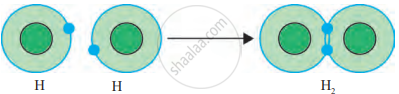
Formation of Covalent bond in the H₂ molecule
(b) Formation of H₂O Molecule (Water):
- Oxygen has 6 valence electrons in its outer shell.
- It needs 2 more electrons to complete its octet.
- Each hydrogen atom has 1 valence electron and needs 1 more electron to complete its duplet.
- The oxygen atom shares 1 electron each with 2 hydrogen atoms, forming two covalent bonds. The octet of the oxygen atom is completed.
- The duplets of the two hydrogen atoms are also completed.
The molecule is represented as H—O—H. 

Formation of Covalent bond in H₂O molecule
(c) Formation of N₂ Molecule (Nitrogen Molecule):
- Each nitrogen atom has 5 valence electrons in its outer shell.
- Nitrogen needs 3 more electrons to complete its octet.
- Two nitrogen atoms share three pairs of electrons (6 electrons in total) to complete their octets.
- This forms a triple covalent bond between the two nitrogen atoms. Both nitrogen atoms achieve a stable octet.
- The molecule is represented as N≡N, where the three dashes represent the triple bond.
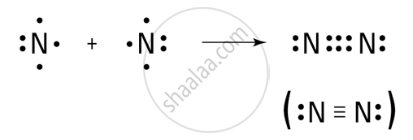
Formation of Covalent bond in the N₂ molecule
Properties of Covalent Compounds:
- Covalent compounds are generally poor conductors of electricity, as they do not have free ions or electrons.
- They have low melting and boiling points due to weak intermolecular forces, despite strong covalent bonds.
- Most covalent compounds are insoluble in water but dissolve in organic solvents like alcohol and benzene.
- They can exist in all three states of matter: solid, liquid, or gas, depending on their molecular structure.
- Covalent compounds are typically brittle and not malleable or ductile.
- They have definite molecular structures with fixed ratios of atoms.
- Reactions involving covalent compounds are often slower compared to ionic compounds due to the breaking and rearranging of covalent bonds.
- They may exhibit polar or non-polar properties, depending on the electronegativity difference between the bonded atoms.
Key Points: The Covalent Bond
- Carbon forms covalent bonds by sharing electrons to achieve a noble gas configuration.
- Covalent bonds can be single, double, or triple, as seen in molecules like H₂, O₂, and N₂.
- Covalent compounds have low melting and boiling points and are poor conductors of electricity.
- Carbon has allotropes such as diamond, graphite, and fullerene (C₆₀), each with different physical properties.
Definition: Covalent Compound
The chemical bond that is formed between two combining atoms by mutual sharing of one or more pairs of electrons is called a covalent (or a molecular) bond, and the compound formed due to this bond is called a covalent compound.
Definition: Covalent Molecule
The molecule formed due to the sharing of electrons (covalent bond) is called a covalent molecule.
Video Tutorials
Shaalaa.com | Carbon and Compounds part 2 (What is special about carbon)
Related QuestionsVIEW ALL [324]
Complete the following activity.
Write the names of the hydrocarbons for the following structural formula.
(isobutylene, cyclohexane, propene, cyclohexene, cyclopentane, benzene, propyne, isobutane, propane)
| \[\begin{array}{cc} \phantom{..}\ce{H}\phantom{...}\ce{H}\phantom{...}\ce{H}\\ \phantom{..}|\phantom{....}|\phantom{....}|\\ \ce{H - C - C- C- H}\\ \phantom{.}|\phantom{....}|\phantom{....}|\\ \ce{H - C - H}\\ |\\\ce{H}\end{array}\] |
