Method of Application
Topics
Chemical Substances-Nature and Behaviour
Chemical Reactions and Equations
- Chemical Reaction
- Characteristics of Chemical Reactions
- Chemical Equations
- Balanced and Unbalanced Chemical Equations
- Balancing Chemical Equation
- Types of Chemical Reactions > Combination Reaction
- Types of Chemical Reactions > Decomposition Reaction
- Types of Chemical Reactions > Single Displacement Reaction
- Types of Chemical Reactions > Double Displacement Reaction
- Types of Chemical Reactions > Reversible and Irreversible Reactions
- Types of Chemical Reactions > Oxidation and Reduction Reactions
- Corrosion of Metals
- Rancidity
World of Living
Acids, Bases and Salts
- Introduction to Acids, Bases and Indicators
- Indicators for Testing Acids and Bases
- Acids
- Properties of Acids
- Common Properties of Acids
- Uses of Acids
- Bases
- Properties of Bases
- Uses of Bases
- Chemical Properties of Acids and Bases
- Common Properties of Acids and Bases
- Strength of Acid and Base Solutions : pH Scale
- Universal Indicator
- Importance of pH in Everyday Life
- Salts
- Salts > Family of Salts
- Salts > pH of Salts
- Common Salt
- Sodium hydroxide
- Washing Soda
- Baking Soda
- Bleaching Powder
- Plaster of Paris
- Water of Crystallisation: Hydrated Salts
Natural Phenomena
Metals and Non-metals
Carbon and its Compounds
Effects of Current
Life Processes
Natural Resources
Control and Coordination
How do Organisms Reproduce?
- DNA Copying and Variation
- The Importance of Variation
- Reproduction
- Modes of Reproduction
- Asexual Reproduction
- Asexual Reproduction in Unicellular Organisms > Binary Fission
- Binary Fission > Simple Binary Fission
- Binary Fission > Longitudinal Binary Fission
- Binary Fission > Transverse Binary Fission
- Asexual Reproduction in Unicellular Organisms > Multiple Fission
- Asexual Reproduction in Multicellular Organisms > Fragmentation
- Asexual Reproduction in Multicellular Organisms > Regeneration
- Asexual Reproduction in Unicellular Organisms > Budding
- Asexual Reproduction in Multicellular Organisms > Budding
- Asexual Reproduction in Multicellular Organisms > Spore Formation
- Vegetative Reproduction or Vegetative Propagation
- Natural Vegetative Propagation
- Artificial Vegetative Propagation
- Tissue Culture
- Sexual Reproduction
- Sexual Reproduction in Plants
- Pollination
- Self-pollination
- Cross-pollination
- Fertilisation in Flowering Plants
- Formation of Seed and Fruit
- Seed Germination
- Sexual Reproduction in Animals
- Puberty
- The Male Reproductive System
- The Female Reproductive System
- Fertilization in Humans
- Menstrual Cycle (Ovarian Cycle)
- Major Events of Menstrual Cycle
- Menarche and Menopause
- Birth Control
- Natural Contraceptive Methods
- Artificial Contraceptive Methods
- Induced Abortion or Medical Termination of Pregnancy (MTP)
- Sexually Transmitted Diseases (STD) or Sexually Transmitted Infections (STI)
- Concept of Reproductive Health
Heredity
- Heredity
- Variation
- Accumulation of Variation During Reproduction
- Gregor Johann Mendel – Father of Genetics
- Monohybrid Cross
- Dihybrid Cross
- Characteristics (or Traits) Transmitted to Progeny
- Inheritance of Blood Groups
- Sex Determination in Humans
- Acquired and Inherited Traits
Light – Reflection and Refraction
- Nature of Light
- Reflection of Light
- Reflection of Light from Plane Surfaces: Plane Mirror
- Law of Reflection of Light
- Regular Reflection and Diffuse Reflection of Light
- Objects and Images
- Images Formed by a Plane Mirrors
- The Position of Image Formed in a Plane Mirror
- Uses of Plane Mirrors
- Spherical Mirrors
- Image Formation by Spherical Mirrors
- Rules for Obtaining Images Formed by Concave Mirrors
- Formation of Different Types of Images by a Concave Mirror
- Representation of Images Formed by Spherical Mirrors Using Ray Diagrams
- Sign Convention for Reflection by Spherical Mirrors
- Mirror Formula and Magnification
- Rules for Obtaining Images Formed by Convex Mirrors
- Formation of Image by a Convex Mirror
- Refraction of Light
- Effects of Refraction of Light
- Laws of Refraction of Light
- Refraction through a Rectangular Glass Slab
- The Refractive Index
- Refraction by Spherical Lenses
- Rules for Obtaining Images Formed by Convex Lenses
- Formation of Different Types of Images by a Convex Lens
- Image Formation by Lenses
- Image Formation in Lenses Using Ray Diagrams
- Sign Convention for Reflection by Spherical Mirrors
- Lens Formula and Magnification
- Lens Formula and Magnification Formulae for a Concave Lens
- Power of a Lens
The Human Eye and the Colourful World
- Human Eye
- Working of the Eye
- Rods and Cones
- Power of Accommodation
- Range of Vision of a Normal Human Eye
- Advantages of Having Two Eyes for Vision
- Defects of Vision and Their Corrections > Myopia
- Defects of Vision and Their Corrections > Hypermetropia
- Defects of Vision and Their Corrections > Presbyopia
- Glass Prism
- Refraction of Light through a Prism
- Dispersion of Light Through a Prism
- The Rainbow
- Atmospheric Refraction
- Scattering of Light
Electricity
- Electric Charges
- Conductors and Insulators
- Electric Potential and Potential Difference
- Electric Current
- Electric Circuit
- Circuit Diagram
- Ohm's Law
- Resistance of a Conductor
- Graph Between V and I
- Experiment to Verify Ohm's Law
- Good Conductors, Resistors and Insulators
- Factors Affecting the Resistance of a Conductor
- Resistivity
- Resistance of a System of Resistors
- Resistors in Series
- Resistors in Parallel
- Domestic Electric Circuits
- Heating Effect of Electric Current
- Practical Applications of Heating Effect of Electric Current
- Electric Power
- Commercial Unit of Electrical Energy
- Effects Produced by Electric Current
- Applications of the Heating Effect of Current
Magnetic Effects of Electric Current
- Introduction to Magnets and Their Properties
- Electromagnetism
- Magnetic Field and Field Lines
- Magnetic Field of Earth
- Magnetic Effect of Current (or Electromagnetism)
- Magnetic Field Due to a Current-Carrying Conductor
- Magnetic Field due to a Current through a Straight Conductor
- Right-hand Thumb Rule
- Magnetic Field due to a Current through a Circular Loop
- Magnetic Field due to a Current in a Solenoid
- Electromagnet
- Magnetism in Human Beings
- Force on a Current-Carrying Conductor in a Magnetic Field
- Domestic Electric Circuits
Our Environment
Maharashtra State Board: Class 10
Magnetic Field Direction Rules
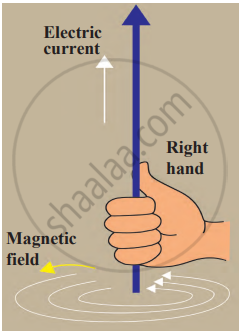
Electromagnetism explains the relationship between electricity and magnetism. When an electric current flows through a conductor, it produces a magnetic field around it. The Right-Hand Thumb Rule and Maxwell’s Corkscrew Rule help determine the magnetic field direction around a current-carrying conductor.
Right Hand Thumb Rule:
| Concept | Explanation |
|---|---|
| Definition | A rule to determine the direction of the magnetic field around a straight current-carrying conductor. |
|
|
Hold the wire in right hand with thumb pointing in the current direction, and curled fingers show the magnetic field direction. |
| Magnetic Field Direction | - Upward Current → Anticlockwise Magnetic Field - Downward Current → Clockwise Magnetic Field |
| Applications | - Used to find magnetic field direction in conductors. - Helps design electromagnets, solenoids, and motors. - Important in electric generators & transformers. |
Maxwell’s Corkscrew Rule:
| Concept | Explanation |
|---|---|
| Definition | A rule that explains the magnetic field direction using a corkscrew analogy. |
| Method of Application | Imagine turning a corkscrew in the direction of the current. The direction in which it moves forward represents the magnetic field direction. |
| Magnetic Field Direction | - Clockwise Corkscrew Rotation → Downward Current, Clockwise Magnetic Field - Anticlockwise Corkscrew Rotation → Upward Current, Anticlockwise Magnetic Field |
| Applications | - Used in physics & engineering to study magnetic fields. - Helps in electromagnetic induction & transformer working. - Useful in coil and solenoid behaviour analysis. |
|
|
Maxwell’s Corkscrew Rule |

Maharashtra State Board: Class 10
CISCE: Class 10
CISCE: Class 10
Definition: Right Hand Thumb Rule
If a current-carrying straight conductor is held in the right hand such that the thumb points in the direction of the electric current, then the fingers curled around the conductor show the direction of the magnetic field.
This is called the Right-Hand Thumb Rule.
OR
If you hold a current-carrying conductor in your right hand with the thumb pointing in the direction of the current, then the curled fingers show the direction of the magnetic field (lines of force) around the conductor.
Shaalaa.com | Right Hand Thumb Rule
to track your progress
Related QuestionsVIEW ALL [19]
|
Given below is a circuit to study the magnetic effect of electric current. ABCD is a cardboard kept perpendicular to the conductor XY. A magnetic compass is placed at the point P of the cardboard. P1 and P2 are the positions of the magnetic compass, before and after passing a current through XY respectively.
|

- Name the rule that is used to predict the direction of deflection of the magnetic compass.
- State the direction of current in the conductor (X to Y or Y to X) when the circuit is complete.
- If resistance R is increased, then what will be the effect on the magnetic lines of force around the conductor?
