Advertisements
Advertisements
प्रश्न
Describe the structure of diamond. Draw a simple diagram to show the arrangement of carbon atoms in diamond.
Advertisements
उत्तर
A crystal of diamond is a molecule of carbon atoms in which each carbon atom is connected to four other carbon atoms by strong covalent bonds forming a regular tetrahedron. As the carbon atoms are held together firmly by covalent bonds, diamond forms a very rigid structure.
The arrangement of carbon atoms in a diamond crystal is shown below:

APPEARS IN
संबंधित प्रश्न
Explain the bonding in methane molecule using electron dot structure.
Name a carbon containing molecule which has two double bonds.
Write the electron-dot structure for the following molecule.
Cl2
State one major difference between covalent and ionic bonds and give one example each of covalent and ionic compounds.
Which inert gas electron configuration do the Cl atoms in Cl2 molecule resemble? What is this electron configuration?
What type of chemical bond is present in chlorine molecule? Explain your answer.
Why is diamond used for making cutting tools (like glass cutters) but graphite is not?
Name one covalent compound containing chlorine.
Write two points of difference in the structures of diamond and graphite.
Which of the following has a triple bond as well as single bonds?
(a) ethene
(b) methane
(c) ethyne
(d) nitrogen
What are the conditions necessary for the formation of covalent molecules?
Elements forming ionic compounds attain noble gas electronic configuration by either gaining or losing electrons from their valence shells. Explain giving reason why carbon cannot attain such a configuration in this manner to form its compounds. Name the type of bonds formed in ionic compounds and in the compounds formed by carbon. Also explain the reason why carbon compounds are generally poor conductors of electricity.
Explain the following:
Covalent compounds are generally gases or liquids or soft solids.
An element L consists of molecules.
What type of bonding is present in the particles that make up L?
Element A has 2 electrons in its M shell. Element B has atomic number 7.
If B is a diatomic gas, write the equation for the direct combination of A and B to form a compound.
Name the anion present in the following compound:
When a barium chloride solution is added to a solution of compound B, a white precipitate insoluble in dilute hydrochloric acid is formed.
Complete the following activity.
Write the names of the hydrocarbons for the following structural formula.
(isobutylene, cyclohexane, propene, cyclohexene, cyclopentane, benzene, propyne, isobutane, propane)
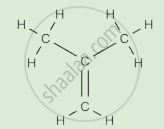 |
Complete the following activity.
Write the names of the hydrocarbons for the following structural formula.
(isobutylene, cyclohexane, propene, cyclohexene, cyclopentane, benzene, propyne, isobutane, propane)
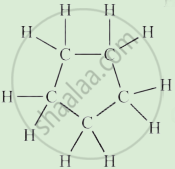 |
Which of the following is the formula of Butanoic acid?
Which of the following are correct structural isomers of butane?
- \[\begin{array}{cc}
\ce{H}\phantom{...}\ce{H}\phantom{...}\ce{H}\phantom{...}\ce{H}\\
|\phantom{....}|\phantom{....}|\phantom{....}|\\
\ce{H - C - C - C - C - H}\\
|\phantom{....}|\phantom{....}|\phantom{....}|\\
\ce{H}\phantom{...}\ce{H}\phantom{...}\ce{H}\phantom{...}\ce{H}\\
\end{array}\] - \[\begin{array}{cc}
\ce{H}\phantom{...}\ce{H}\phantom{...}\ce{H}\\
|\phantom{....}|\phantom{....}|\\
\ce{H - C - C - C - H}\\
|\phantom{.....}|\phantom{.....}|\\
\ce{H}\ce{H-C-H}\ce{H}\\
|\\
\ce{H}\\
\end{array}\] - \[\begin{array}{cc}
\ce{H}\phantom{...}\ce{H}\phantom{...}\ce{H}\\
|\phantom{....}|\phantom{....}|\\
\ce{H - C - C - C - H}\\
|\phantom{.....}\backslash\phantom{..}|\\
\phantom{....}\ce{H}\phantom{......}\ce{C - H}\phantom{}\\
\phantom{.......}|\\
\phantom{.......}\ce{H}\\
\end{array}\] - \[\begin{array}{cc}
\ce{H}\phantom{...}\ce{H}\\
|\phantom{....}|\\
\ce{H - C - C - H}\\
|\phantom{....}|\\
\ce{H - C - C - H}\\
|\phantom{....}|\\
\ce{H}\phantom{...}\ce{H}\\
\end{array}\]
