Advertisements
Advertisements
प्रश्न
Describe the structure of diamond. Draw a simple diagram to show the arrangement of carbon atoms in diamond.
Advertisements
उत्तर
A crystal of diamond is a molecule of carbon atoms in which each carbon atom is connected to four other carbon atoms by strong covalent bonds forming a regular tetrahedron. As the carbon atoms are held together firmly by covalent bonds, diamond forms a very rigid structure.
The arrangement of carbon atoms in a diamond crystal is shown below:

APPEARS IN
संबंधित प्रश्न
State the reason to explain why covalent compounds "have low melting and boiling points."
Name a carbon containing molecule which has two double bonds.
Give one example, state what are covalent compounds?
How buckminsterfullerene is it related to diamond and graphite?
Using electron-dot diagrams which show only the outermost shell electrons, show how a molecule of nitrogen, N2, is formed from two nitrogen atoms. What name is given to this type of bonding? (Atomic number of nitrogen is 7)
Explain why, diamond is hard while graphite is soft (though both are made of carbon atoms).
Explain why, diamond can be used in rock drilling equipment but graphite cannot.
State one use of diamond which depends on its 'extraordinary brilliance' and one use of graphite which depends on its being 'black and quite soft'.
Why are covalent compounds generally poor conductors of electricity?
A solid element X has four electrons in the outermost shell of its atom. An allotrope Y of this element is used as a dry lubricant in machinery and also in making pencil leads.
(a) What is element X?
(b) Name the allotrope Y.
(c) State whether allotrope Y is a good conductor or non-conductor of electricity.
(d) Name one use of allotrope Y (other than lubrication and pencil leads)
(e) Name two other allotropes of element X.
Complete the following:
In case of non-polar covalent bond, the covalent bond is formed in the ______ of atoms and shared electrons are ______ distributed. (corner, middle, equally, unequally)
Distinguish between ionic and covalent compounds under the following properties:
(i) Strength of forces between constituent elements
(ii) Solubility of compounds in water
(iii) Electrical conduction in substances
Draw an electron dot structure of the following molecule. (Without showing the circle) :
Methane
Explain the following term with example.
Alkane
Draw the electron dot diagram and structure of nitrogen molecule.
Answer the following question.
What is methane? Draw its electron dot structure. Name the type of bonds formed in this compound. Why are such compounds:
(i) poor conductors of electricity? and
(ii) have low melting and boiling points? What happens when this compound burns in oxygen?
The number of electrons in the valence shell of a carbon atom is 4.
Complete the following activity.
Write the names of the hydrocarbons for the following structural formula.
(isobutylene, cyclohexane, propene, cyclohexene, cyclopentane, benzene, propyne, isobutane, propane)
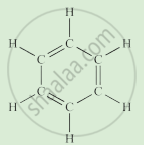 |
Consider the coordination compound, K2[Cu(CN)4]. A coordinate covalent bond exists between:
______ is an example of a covalent compound having a high melting point.
