Advertisements
Advertisements
प्रश्न
What is diamond? Of what substance is diamond made?
Advertisements
उत्तर
Diamond, which is a colourless and transparent substance, is an allotrope of carbon. It is the hardest natural substance known. Diamonds are purely made of carbon and the symbol is C. When we burn diamond in oxygen, only carbon dioxide is evolved showing that diamond is made up of carbon.
APPEARS IN
संबंधित प्रश्न
List three characteristic properties of covalent compounds.
What type of chemical bond is formed between carbon and bromine?
Give two general properties of ionic compounds and two those of covalent compounds.
Explain why, ionic compounds conduct electricity in solution whereas covalent compounds do not conduct electricity.
will CCl4 conduct electricity or not?
give reason for your choice.
Give the formula of the compound that would be formed by the combination of the following pair of elements:
Al and Cl2
Draw the electron-dot structure of NH3 and state the type of bonding.
Explain why, diamond can be used in rock drilling equipment but graphite cannot.
State any two uses of diamond.
Describe the structure of graphite with the help of a labelled diagram.
What is the difference between ionic compounds and covalent compounds?
The following structural formula belongs to which carbon compound?
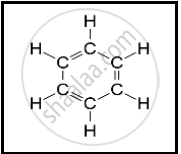
Name the types of Hydrocarbons.
Give an example for each of the following statement
A compound in which two Covalent bonds are formed.
Cation is formed when ______.
Which of the following compounds of carbon does not consist of ions?
Statement (A): Covalent compounds are bad conductors of electricity.
Reason (B): Covalent compounds contain charged particles (ions)
Write notes on the characteristics of covalent compounds.
"Carbon prefers to share its valence electrons with other atoms of carbon or with atoms of other elements rather than gaining or losing the valence electrons in order to attain noble gas configuration." Give reasons to justify this statement.
The electron dot structure of chlorine molecule is:
