Advertisements
Advertisements
प्रश्न
Give two general properties of ionic compounds and two those of covalent compounds.
Advertisements
उत्तर
| Ionic Compounds | Covalent Compounds |
| Ionic compounds usually have high melting and boiling points. | Covalent compounds usually have low melting and boiling points. |
| Ionic compounds generally conduct electricity when dissolved in water or in a molten state. | Covalent compounds usually do not conduct electricity. |
APPEARS IN
संबंधित प्रश्न
State the reason to explain why covalent compounds "have low melting and boiling points."
Buckminsterfullerene is spherical molecule in which 60 carbon atoms are arranged in interlocking hexagonal and pentagonal rings of carbon atoms.
How many hexagons of carbon atoms are present in one molecule of buckminsterfullerene?
Which inert gas electron configuration do the Cl atoms in Cl2 molecule resemble? What is this electron configuration?
Explain why covalent compounds have generally high melting points?
Draw the electron-dot structure of NH3 and state the type of bonding.
State any two uses of graphite.
The atomic numbers of four elements P, Q, R and S are 6, 10, 12 and 17 respectively. Which two elements can combine to form a covalent compound?
(a) P and R
(b) Q and S
(c) P and S
(d) R and S
Two non-metals combine with each other by the sharing of electrons to form a compound X.
(a) What type of chemical bond is present in X?
(b) State whether X will have a high melting point or low melting point.
(c) Will it be a good conductor of electricity or not?
(d) Will it dissolve in an organic solvent or not?
What do you understand by polar covalent compounds?
Methane molecule is non-polar molecule. Explain.
Draw an electron dot diagram for the formation of the following. State the type of bonding present in them.
Hydroxyl ion
Distinguish between ionic and covalent compounds under the following properties:
(i) Strength of forces between constituent elements
(ii) Solubility of compounds in water
(iii) Electrical conduction in substances
Explain the following term with example.
Covalent bond
Explain why carbon tetrachloride does not dissolve in water.
Name gas with a rotten egg smell.
Define the functional group and complete the following table.
| S.I. No. | Functional Group | Compound | Formula |
| (1) | ______________ | _______________ |
C2H5OH |
| (2) | _______________ | _______________ | CH3CHO |
Complete the following activity.
Write the names of the hydrocarbons for the following structural formula.
(isobutylene, cyclohexane, propene, cyclohexene, cyclopentane, benzene, propyne, isobutane, propane)
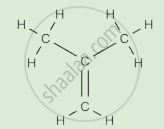 |
Complete the following activity.
Write the names of the hydrocarbons for the following structural formula.
(isobutylene, cyclohexane, propene, cyclohexene, cyclopentane, benzene, propyne, isobutane, propane)
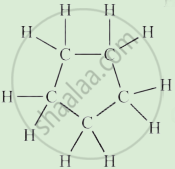 |
Give an example for each of the following statement.
Formation of coordinate covalent bond between NH3 ➝ BF3 molecules
