Advertisements
Advertisements
प्रश्न
A solid element X has four electrons in the outermost shell of its atom. An allotrope Y of this element is used as a dry lubricant in machinery and also in making pencil leads.
(a) What is element X?
(b) Name the allotrope Y.
(c) State whether allotrope Y is a good conductor or non-conductor of electricity.
(d) Name one use of allotrope Y (other than lubrication and pencil leads)
(e) Name two other allotropes of element X.
Advertisements
उत्तर
(a) The solid element 'X' is carbon, which has four electrons in the outermost shell of its atom.
(b) Graphite is the allotrope 'Y' of carbon which is used as a dry lubricant in machinery, and al in making pencil leads.
(c) Graphite (Y) is a good conductor of electricity because of the presence of free electrons in its crystal.
(d) Graphite (Y) is used in making carbon electrodes or graphite electrodes in dry cells and electric arcs.
(e) Diamond and buckminsterfullerene are the two other allotropes of carbon.
APPEARS IN
संबंधित प्रश्न
Explain the bonding in methane molecule using electron dot structure.
Name the element whose one of the allotropic forms is buckminsterfullerene.
What would be the electron-dot structure of carbon dioxide which has the formula CO2?
Fill in the following blank with suitable word:
The general formula CnH2n for cycloalkanes is the same as that of ...........
What type of bond is present in oxygen molecule?
Give one example, state what are covalent compounds?
Give two general properties of ionic compounds and two those of covalent compounds.
What is diamond? Of what substance is diamond made?
Draw an electron dot structure of the following molecule. (Without showing the circle) :
Methane
Draw an electron dot structure of the following molecule. (Without showing the circle) :
Ethene
Draw all possile structural formulae of compound from their molecular formula given below.
C4H10
Explain the following:
Non-polar covalent compounds are insoluble in water.
State the type of bond formed when the combining atom has zero E.N. difference.
Complete the following activity.
Write the names of the hydrocarbons for the following structural formula.
(isobutylene, cyclohexane, propene, cyclohexene, cyclopentane, benzene, propyne, isobutane, propane)
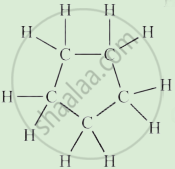 |
List two differences between the properties exhibited by covalent compounds and ionic compounds.
Discuss in brief about the properties of coordinate covalent compounds.
Which of the following is the purest form of carbon?
Oils on treating with hydrogen in the presence of palladium or nickel catalyst form fats. This is an example of
What is a covalent bond?
