Advertisements
Advertisements
प्रश्न
Explain the following:
Non-polar covalent compounds are insoluble in water.
Advertisements
उत्तर
On the basis of principle like dissolves like we can interpret the insolubility of non polar covalent compounds. Since water is a polar covalent compound that is it has positively and negatively charged ends but the non-polar covalent compounds do not have any kind of charge separation. So water molecules are unable to interact with the molecules of non polar compound and break apart the intermolecular forces of attraction among non-polar molecules making them soluble in water.
संबंधित प्रश्न
Draw the electron-dot structure of the following compound and state the type of bonding in the given case:
NH3
The electronic configurations of two elements A and B are given below:
| A | 2, 6 |
| B | 2, 8, 1 |
- What type of chemical bond is formed between the two atoms of A?
- What type of chemical bond will be formed between the atoms of A and B?
Give two example in following case:
Gaseous non polar covalent compound.
Which element exhibits the property of catenation to maximum extent and why?
Draw an electron dot structure of the following molecule. (Without showing the circle) :
Methane
Give examples for the following:
Two gaseous non polar compounds.
Electrons are getting added to an element Y:
Is Y getting oxidised or reduced?
State the type of bond formed when the combining atom has small E.N. difference.
The bond between two oxygen atoms is _______ bond.
Complete the following activity.
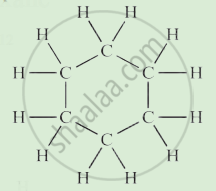
Write the names of the hydrocarbons for the following structural formula.
(isobutylene, cyclohexane, propene, cyclohexene, cyclopentane, benzene, propyne, isobutane, propane)
 |
