Advertisements
Advertisements
प्रश्न
Advertisements
उत्तर
The necessary conditions for the formation of covalent molecule are:
Number of valence electrons: Both the participating atoms should have four or more valence electrons in their valence shell.
Equal electro negativities: The combining atoms should have equal electro negativities so that no transfer of electrons takes place.
Equal electron affinities: The combining atoms should also have equal electron affinities i.e. equal attraction for electrons.
Ionization energy: It should be high for both the atoms so that there is no chance of removal of electrons.
High nuclear charge and small inter nuclear distance: Both these conditions favor the formation of covalent bond because during the formation of a covalent bond the electron density gets concentrated between the nuclei of the combining atoms and this electronic charge is responsible for holding the two nuclei together.
The properties of covalent compounds are:
Nature: They are generally volatile liquids or gases. Some may be gases like urea, sugar etc.
Low melting and boiling points: Since the intermolecular forces of attraction are weak, very small amount of heat energy is required to overcome these forces hence their melting and boiling points are low.
Electrical conductivity: Since covalent compounds are made up of molecules and not ions, so they do not conduct electricity.
Solubility: These are insoluble in water but soluble in organic solvents.
Ionization in solution: These do not ionize when dissolved in water except some polar covalent compounds like HCl.
Molecular reactions: These participate in reactions as a molecule so the reactions are called molecular reactions. These are slow reactions.
APPEARS IN
संबंधित प्रश्न
The form of carbon which is known as black lead is ______.
Compare the properties of ionic compounds and covalent compounds.
The molecules having triple bond in them are ______.
A saturated hydrocarbon has fifty hydrogen atoms in its moleucle. The number of carbon atoms in its molecule will be ______.
State the type of bonding in the following molecule.
Hydroxyl ion
Choose the correct answer from the options given below
Condition favorable for formation of a covalent bond is
The electronic configuration of N2 is 2, 5. How many electrons in the outer shell of a N atom are not involved in the formation of a nitrogen molecule?
What do you understand by dipole (polar) molecule?
Complete the following activity.
Write the names of the hydrocarbons for the following structural formula.
(isobutylene, cyclohexane, propene, cyclohexene, cyclopentane, benzene, propyne, isobutane, propane)
| \[\begin{array}{cc} \phantom{.........}\ce{H}\\ \phantom{.........}|\\ \ce{H - C ≡ C - C - H}\\ \phantom{.........}|\\ \phantom{.........}\ce{H} \end{array}\] |
Complete the following activity.
Write the names of the hydrocarbons for the following structural formula.
(isobutylene, cyclohexane, propene, cyclohexene, cyclopentane, benzene, propyne, isobutane, propane)
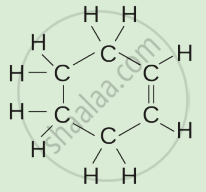 |
