Advertisements
Advertisements
प्रश्न
The atomic numbers of four elements P, Q, R and S are 6, 10, 12 and 17 respectively. Which two elements can combine to form a covalent compound?
(a) P and R
(b) Q and S
(c) P and S
(d) R and S
Advertisements
उत्तर
(c) P and S
Element P needs 4 electrons to complete its octet. They can be shared with element S, which needs only 1 electron to complete its octet.
APPEARS IN
संबंधित प्रश्न
List three characteristic properties of covalent compounds.
Ethane, with the molecular formula C2H6 has ______.
Name the following:
The property of element by virtue of which atoms of the element can link to each other in the form of a long chain or ring structure.
What type of bonds are present in CH4 molecule? Draw their electron-dot structures.
What is a covalent bond?
What type of bond exist in CCl4?
Two non-metals combine with each other by the sharing of electrons to form a compound X.
(a) What type of chemical bond is present in X?
(b) State whether X will have a high melting point or low melting point.
(c) Will it be a good conductor of electricity or not?
(d) Will it dissolve in an organic solvent or not?
The pencil leads are made of mainly:
(a) lithium
(b) charcoal
(c) lead
(d) graphite
Taking hydrogen chloride and methane as examples, distinguish between a polar covalent bond and a non polar covalent bond.
Give examples for the following:
Two gaseous non polar compounds.
Choose the correct answer from the options given below
Condition favorable for formation of a covalent bond is
Explain why Carbon tetrachloride does not dissolve in water.
Name a neutral covalent molecule which contains one lone pair of electrons.
The following table shows the electronic configuration of the elements W, X, Y, Z:
|
Element |
W |
X |
Y |
Z |
|
Electronic |
2,8,1 |
2,8,7 |
2,5 |
1 |
Answer the following questions based on the table above:
What type of bond is formed between Y and Z.
Fill in the blank from the choice given in bracket.
The compound that does not have a lone pair of electrons is ___________. (Water, Ammonia, carbon tetrachloride)
Write an Explanation.
Alkyne
Write a short note.
Characteristics of carbon
Complete the following activity.
Write the names of the hydrocarbons for the following structural formula.
(isobutylene, cyclohexane, propene, cyclohexene, cyclopentane, benzene, propyne, isobutane, propane)
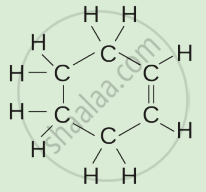 |
An element A is soft and can be cut with a knife. This is very reactive to air and cannot be kept open in air. It reacts vigorously with water. Identify the element from the following
