Advertisements
Advertisements
प्रश्न
Name the hardest natural substance known.
Advertisements
उत्तर
Diamond is the hardest natural substance known.
APPEARS IN
संबंधित प्रश्न
Elements forming ionic compounds attain noble gas configuration by either gaining or losing electrons from their outermost shells. Give reason to explain why carbon cannot attain noble gas configuration in this manner to form its compounds.
Why does carbon form compounds mainly by covalent bonding?
Give one example, state what are covalent compounds?
Why is diamond used for making cutting tools (like glass cutters) but graphite is not?
State one test by which sodium chloride can be distinguished from sugar.
Draw the electron-dot structure of H2O compound and state the type of bonding.
Explain why, graphite can be used as a lubricant but diamond cannot.
The atomic numbers of four elements P, Q, R and S are 6, 10, 12 and 17 respectively. Which two elements can combine to form a covalent compound?
(a) P and R
(b) Q and S
(c) P and S
(d) R and S
Two non-metals combine with each other by the sharing of electrons to form a compound X.
(a) What type of chemical bond is present in X?
(b) State whether X will have a high melting point or low melting point.
(c) Will it be a good conductor of electricity or not?
(d) Will it dissolve in an organic solvent or not?
Give two example in following case:
Gaseous non polar compounds
Give two example in following case:
Liquid non polar compounds
Draw electron - dot structure and structural formula of methane.
Explain the following briefly:
Sodium chloride dissolves in water but carbon tetra chloride is insoluble in water.
In the formation of electrovalent compounds, electrons are transferred from one element to another. How are electrons involved in the formation of a covalent compound?
Acids dissolve in water and produce positively charged ions. Draw the structure of these positive ions.
Draw the electron dot diagram and structure of magnesium chloride.
Complete the following activity.
Write the names of the hydrocarbons for the following structural formula.
(isobutylene, cyclohexane, propene, cyclohexene, cyclopentane, benzene, propyne, isobutane, propane)
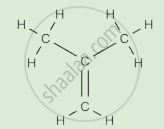 |
Complete the following activity.
Write the names of the hydrocarbons for the following structural formula.
(isobutylene, cyclohexane, propene, cyclohexene, cyclopentane, benzene, propyne, isobutane, propane)
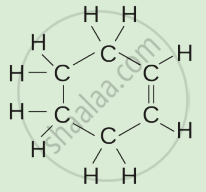 |
Discuss in brief about the properties of coordinate covalent compounds.
Name the following:
\[\ce{CH3 - CH2CH = CH2}\]
