Advertisements
Advertisements
प्रश्न
Two non-metals combine with each other by the sharing of electrons to form a compound X.
(a) What type of chemical bond is present in X?
(b) State whether X will have a high melting point or low melting point.
(c) Will it be a good conductor of electricity or not?
(d) Will it dissolve in an organic solvent or not?
Advertisements
उत्तर
(a) Covalent bond is present compound X because it is formed by sharing of electrons.
(b) Compound X has a low melting point because it is a covalent compound.
(c) Being a covalent compound, it will not be a good conductor of electricity.
(d) Covalent compounds dissolve in an organic solvent. Since X is a covalent compound, it will dissolve in an organic solvent.
APPEARS IN
संबंधित प्रश्न
Elements forming ionic compounds attain noble gas configuration by either gaining or losing electrons from their outermost shells. Give reason to explain why carbon cannot attain noble gas configuration in this manner to form its compounds.
Compare the properties of ionic compounds and covalent compounds.
State one test by which sodium chloride can be distinguished from sugar.
Write two points of difference in the structures of diamond and graphite.
A covalent molecule having a double bond between its atoms is:
(a) Hydrogen
(b) Oxygen
(c) water
(d) ammonia
The electronic configurations of two elements A and B are given below:
| A | 2, 6 |
| B | 2, 8, 1 |
(a) What type of chemical bond is formed between the two atoms of A?
(b) What type of chemical bond will be formed between the atoms of A and B?
Define a covalent bond.
State the type of bonding in the following molecule.
Methane
Give two example in following case:
Solid covalent compounds
Draw all possible structural formulae of compound from their molecular formula given below.
C3H8
Explain the Structural isomerism term with example.
Observe the straight chain hydrocarbons given below and answer the following
questions :
i) Which of the straight chain compounds from A and B is saturated and unsaturated straight chains?
ii) Name these straight chains.
iii) Write their chemical formulae and number of – CH2 - units.
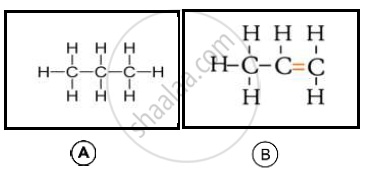
Give examples for the following:
Two solid covalent compounds.
Number of valence electrons in a carbon atom is _______.
Carbon forms four covalent bonds by sharing its four valence electrons with four univalent atoms, e.g., hydrogen. After the formation of four bonds, carbon attains the electronic configuration of ______.
Which of the following is the formula of Butanoic acid?
The table shows the electronic structures of four elements.
| Element | Electronic Structure |
| P | 2, 6 |
| Q | 2, 8, 1 |
| R | 2, 8, 7 |
| S | 2, 8, 8 |
- Identify which element(s) will form covalent bonds with carbon.
- “Carbon reacts with an element in the above table to form several compounds.” Give suitable reason.
Write notes on the characteristics of covalent compounds.
State the reasons, why carbon cannot
- Lose four electrons to form C4+ cation and
- Gain four electrons to form C4- anion.
How does carbon overcome this problem to form compounds?
Assertion (A): Melting point and boiling point of ethanol are lower than that of sodium chloride.
Reason (R): The forces of attraction between the molecules of ionic compounds are very strong.
