Advertisements
Advertisements
Question
Two non-metals combine with each other by the sharing of electrons to form a compound X.
(a) What type of chemical bond is present in X?
(b) State whether X will have a high melting point or low melting point.
(c) Will it be a good conductor of electricity or not?
(d) Will it dissolve in an organic solvent or not?
Advertisements
Solution
(a) Covalent bond is present compound X because it is formed by sharing of electrons.
(b) Compound X has a low melting point because it is a covalent compound.
(c) Being a covalent compound, it will not be a good conductor of electricity.
(d) Covalent compounds dissolve in an organic solvent. Since X is a covalent compound, it will dissolve in an organic solvent.
APPEARS IN
RELATED QUESTIONS
Which inert gas electron configuration do the Cl atoms in Cl2 molecule resemble? What is this electron configuration?
Give one example of a molecule containing a double covalent bond
Give one example, state what are covalent compounds?
What type of bonding would you expect between Carbon and Chlorine?
Draw the electron-dot structure of H2O compound and state the type of bonding.
State one use of diamond which depends on its 'extraordinary brilliance' and one use of graphite which depends on its being 'black and quite soft'.
Give the formulae of the chlorides of the elements X and Y having atomic numbers of 3 and 6 respectively. Will the properties of the two chlorides be similar or different? Explain your answer.
Give examples for the following:
Two gaseous polar compounds.
Fill in the blank with correct word from the bracket.
Melting and boiling points of covalent compounds are generally ______ (low, high).
Draw the electron dot diagram and structure of nitrogen molecule.
Element A has 2 electrons in its M shell. Element B has atomic number 7.
If the compound formed between A and B is melted and an electric current is passed through the molten compound, the element A will be obtained at the ______ and B at the ______ of the electrolytic cell.
Taking MgCl2 as an electrovalent compound, CCl4 as a covalent compound, give four difference between electrovalent and covalent compounds
Write an Explanation.
Alkyne
Complete the following activity.
Write the names of the hydrocarbons for the following structural formula.
(isobutylene, cyclohexane, propene, cyclohexene, cyclopentane, benzene, propyne, isobutane, propane)
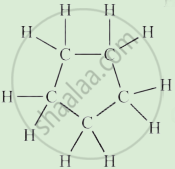 |
Give an example for each of the following statement.
A compound in which three covalent bonds are formed.
Which of the following statements are correct for carbon compounds?
- Most carbon compounds are good conductors of electricity.
- Most carbon compounds are poor conductors of electricity.
- Force of attraction between molecules of carbon compounds is not very strong.
- Force of attraction between molecules of carbon compounds is very strong.
Which of the following compound(s) possesses a high melting point?
Molecular reactions are ______ in the covalent compound.
Assertion (A): Melting point and boiling point of ethanol are lower than that of sodium chloride.
Reason (R): The forces of attraction between the molecules of ionic compounds are very strong.
