Advertisements
Advertisements
Question
Using electron-dot diagrams which show only the outermost shell electrons, show how a molecule of nitrogen, N2, is formed from two nitrogen atoms. What name is given to this type of bonding? (Atomic number of nitrogen is 7)
Advertisements
Solution
The atomic number of nitrogen is 7. Its electronic configuration is 2, 5. Hence, it contains five electrons in its outermost shell.

Three electrons from each nitrogen atom are shared to complete its octet. This sharing of electrons results in covalent bonding in a nitrogen molecule.
APPEARS IN
RELATED QUESTIONS
What would be the electron dot structure of carbon dioxide which has the formula CO2?
What do you call the compounds having the same molecular formula but different structural arrangements of atoms?
What is a covalent bond?
Compare the properties of ionic compounds and covalent compounds.
Give the formula of the compound that would be formed by the combination of the following pair of elements:
Al and Cl2
Why are covalent compounds generally poor conductors of electricity?
An element A has 4 valence electrons in its atom whereas element B has only one valence electron in its atom. The compound formed by A and B does not conduct electricity. What is the nature of chemical bond in the compound formed? Give its electron-dot structure.
Define a covalent bond.
Methane molecule is non-polar molecule. Explain.
Draw all possile structural formulae of compound from their molecular formula given below.
C4H10
Explain the following term with example.
Covalent bond
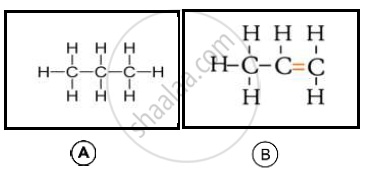
Observe the straight chain hydrocarbons given below and answer the following
questions :
i) Which of the straight chain compounds from A and B is saturated and unsaturated straight chains?
ii) Name these straight chains.
iii) Write their chemical formulae and number of – CH2 - units.
Give examples for the following:
Two gaseous polar compounds.
Choose the correct answer from the options given below
Condition favorable for formation of a covalent bond is
An element L consists of molecules.
What type of bonding is present in the particles that make up L?
Element A has 2 electrons in its M shell. Element B has atomic number 7.
If B is a diatomic gas, write the equation for the direct combination of A and B to form a compound.
What is the difference between :
Ionic compounds and covalent compounds
Two carbon atoms can always form one or two covalent bonds.
An element A is soft and can be cut with a knife. This is very reactive to air and cannot be kept open in air. It reacts vigorously with water. Identify the element from the following
Show the covalent bond formation in nitrogen molecule.
