Advertisements
Advertisements
प्रश्न
Define a covalent bond.
Advertisements
उत्तर
The chemical bond formed between two combining atoms by mutual sharing of one or more pairs of electrons is called a covalent bond.
संबंधित प्रश्न
Give reason why carbon compounds are generally poor conductors of electricity.
What would be the electron dot structure of carbon dioxide which has the formula CO2?
Choose the correct answer from the options given below:
Which of the following is a common characteristic of a covalent compound?
1) high melting point
2) consists of molecules
3) always soluble in water
4) Conducts electricity when it is in the molten state
State the type of bonding in the following molecule.
Water
Buckminsterfullerene is spherical molecule in which 60 carbon atoms are arranged in interlocking hexagonal and pentagonal rings of carbon atoms.
How many pentagons of carbon atoms are present in one molecule of buckminsterfullerene?
What type of bond is present in the following molecule?
O2
What type of bond exists in CCl4?
Draw the electron-dot structure of the following compound and state the type of bonding in the given case:
NH3
Write two points of difference in the structures of diamond and graphite.
The solution of one of the following compounds will not conduct electricity. This compound is:
Which of the following cannot exhibit isomerism?
The number of isomers formed by the hydrocarbon with molecular formula C5H12 is ______.
Draw an electron dot diagram for the formation of the following. State the type of bonding present in them.
Hydroxyl ion
Draw the electron dot diagram and structure of methane.
Element A has 2 electrons in its M shell. Element B has atomic number 7.
- Write equations to show how A and B form ions.
- If B is a diatomic gas, write the equation for the direct combination of A and B to form a compound.
- If the compound formed between A and B is melted and an electric current is passed through the molten compound, the element A will be obtained at the ______ and B at the ______ of the electrolytic cell.
What is the difference between :
Ionic compounds and covalent compounds
Define the functional group and complete the following table.
| S.I. No. | Functional Group | Compound | Formula |
| (1) | ______________ | _______________ |
C2H5OH |
| (2) | _______________ | _______________ | CH3CHO |
Complete the following activity.
Write the names of the hydrocarbons for the following structural formula.
(isobutylene, cyclohexane, propene, cyclohexene, cyclopentane, benzene, propyne, isobutane, propane)
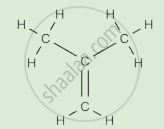 |
Although metals form basic oxides, which of the following metals form an amphoteric oxide?
Non-polar covalent compounds are ______ conductors of heat and electricity.
