Advertisements
Advertisements
Question
Define a covalent bond.
Advertisements
Solution
The chemical bond formed between two combining atoms by mutual sharing of one or more pairs of electrons is called a covalent bond.
RELATED QUESTIONS
Write the number of covalent bonds in the molecule of butane, C4H10.
Give appropriate scientific reasons for Carbon tetrachloride does not conduct electricity.
What type of chemical bond is formed between:
Carbon and bromine
Write the electron-dot structure for the following molecule:
Cl2
Which inert gas does the Cl atom in HCl resemble in electron arrangement?
Draw the electron-dot structure of the following compound and state the type of bonding in the given case:
H2O
Write two points of difference in the structures of diamond and graphite.
Out of KCl, HCl, CCl4 and NaCl, the compounds which are not ionic are:
The number of isomers formed by the hydrocarbon with molecular formula C5H12 is ______.
Give two example in following case:
Gaseous non polar covalent compound.
Draw an electron dot structure of the following molecule. (Without showing the circle) :
Methanol
What do you understand by lone pair?
(a) Compound X consists of molecules.
Choose the letter corresponding to the correct answer from the choices (a), (b), (c) and (d) given below
The type of bonding in X will be
The electronic configuration of N2 is 2, 5. How many electrons in the outer shell of a N atom are not involved in the formation of a nitrogen molecule?
Explain why carbon tetrachloride does not dissolve in water.
What do you understand by dipole (polar) molecule?
Name a greenish-yellow gas which also bleaches.
From the following hydrocarbon _______ is the cyclic hydrocarbon.
Complete the following activity.
Write the names of the hydrocarbons for the following structural formula.
(isobutylene, cyclohexane, propene, cyclohexene, cyclopentane, benzene, propyne, isobutane, propane)
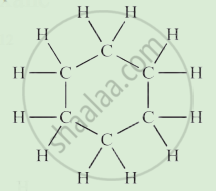 |
