Advertisements
Advertisements
Question
The particles present in strong electrolytes are
Options
Only molecules
Mainly ions
Ions and molecules
Only atoms
Advertisements
Solution
Mainly ions
The particles present in strong electrolytes are Mainly ions.
APPEARS IN
RELATED QUESTIONS
Explain the nature of the covalent bond using the bond formation in CH3Cl.
What type of bond is present in the following molecule?
H2
Why does carbon form compounds mainly by covalent bonding?
Draw the electron-dot structure of the following compound and state the type of bonding in the given case:
N2
The following structural formula belongs to which carbon compound?
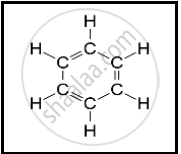
Compound X consists of molecules.
Choose the letter corresponding to the correct answer from the options A, B, C and D given below:
X is likely to have a ______.
Draw the electron dot diagram and structure of methane.
Covalent bonds can be single, double or triple covalent bonds. How many electrons are shared in each? Give an example of each type.
Taking MgCl2 as an electrovalent compound, CCl4 as a covalent compound, give four difference between electrovalent and covalent compounds
The table shows the electronic structures of four elements.
| Element | Electronic Structure |
| P | 2, 6 |
| Q | 2, 8, 1 |
| R | 2, 8, 7 |
| S | 2, 8, 8 |
- Identify which element(s) will form covalent bonds with carbon.
- “Carbon reacts with an element in the above table to form several compounds.” Give suitable reason.
