Advertisements
Advertisements
Question
Study the extract of the Periodic Table given below and answer the questions that follow. Give the alphabet corresponding to the element in question. DO NOT repeat an element.
- Which element forms covalent compound with G?
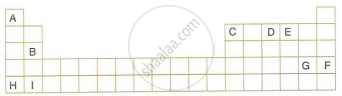
- The ion of which element will migrate towards the cathode during electrolysis?
- Which non-metallic element has the valency 2?
- Which is an inert gas?
- Which element has the lowest electronegativity in the second column?
- Which element is the most metallic?
- State the type of bond formed between I and E. Write its formula.
- Draw the electron dot diagram of the compound formed between I and G.
Chemical Equations/Structures
Very Long Answer
Advertisements
Solution
- G being present in group 17 is a non-metal; covalent bonds form between non-metals. Element A being a non-metal shares its single electron with G to form the stable molecule AG.
- The cathode is the negative electrode, attracting positive ions (cations). Element B is a metal that loses electrons to form a B2+ cation.
- E is a non metal which belongs to group 16. Hence has the valency of 2.
- F is present in group 18 and all group 18 elements are inert gases.
- Electronegativity decreases down a group. In the second column, I is below B, so I has the lowest electronegativity.
- Metallic character increases down a group and decreases from left to right across a period. Since H is towards the bottom left of the given table, it is the most metallic element.
- I is a metal of group 2 and has valency 2. E is a non-metal of group 16 and also has valency 2. Therefore, electrons are transferred from I to E, forming an ionic compound with the formula IE.
\[ \begin{array}{ccccl} & & \begin{array}{c} {\scriptstyle \bullet\,\bullet} \\[-4pt] {\scriptstyle \bullet}\,\mathrm{G}\,\begin{smallmatrix} \bullet \\[-4pt] \bullet \end{smallmatrix} \\[-4pt] {\scriptstyle \bullet\,\bullet} \end{array} & & \\[-4pt] & {\Large \nearrow} & & & \\[-6pt] \mathrm{I}\,\begin{smallmatrix} \bullet \\[-4pt] \bullet \end{smallmatrix} & + & & \quad \longrightarrow \quad & [\,\mathrm{I}\,]^{2+}\;\; 2\left[ \begin{array}{c} {\scriptstyle \bullet\,\bullet} \\[-4pt] \begin{smallmatrix} \bullet \\[-4pt] \bullet \end{smallmatrix}\,\mathrm{G}\,\begin{smallmatrix} \bullet \\[-4pt] \bullet \end{smallmatrix} \\[-4pt] {\scriptstyle \bullet\,\bullet} \end{array} \right]^{-} \\[-6pt] & {\Large \searrow} & & & \\[-4pt] & & \begin{array}{c} {\scriptstyle \bullet\,\bullet} \\[-4pt] {\scriptstyle \bullet}\,\mathrm{G}\,\begin{smallmatrix} \bullet \\[-4pt] \bullet \end{smallmatrix} \\[-4pt] {\scriptstyle \bullet\,\bullet} \end{array} & & \end{array} \]
shaalaa.com
Is there an error in this question or solution?
